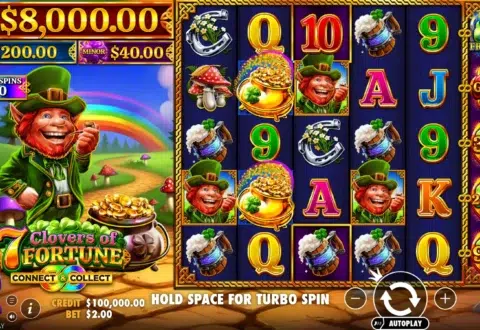
Playson’s recent releases have leaned heavily on Hold and Win. Golden Penny x1000 is a deliberate step sideways. Scatter pays on a 6×5 grid, cluster-based wins, a cascade engine, and a multiplier system that accumulates across the entire free spins round rather than applying spin by spin. It’s a meaningful format change for the studio, and whether it lands depends on how comfortable you are with high variance and a main game that exists largely to deliver you into the bonus.
Eight or more identical symbols anywhere on the 6×5 grid form a winning combination. Position is irrelevant; only the total count of matching symbols determines the payout tier. Once a cluster is identified, those symbols collapse, and new ones fall from above. If the refreshed grid produces another cluster of eight or more, the cascade continues. The chain runs until no new combinations form. A single spin can therefore produce multiple consecutive wins, each calculated separately before the Total Multiplier is applied at the end of the sequence.
Clover-stamped coin symbols land on the reels carrying random multiplier values from x2 up to x1000, across a fixed range of x2, x3, x4, x5, x6, x8, x10, x12, x15, x20, x25, x30, x50, x100, x250, x500 and x1000. When the cascade sequence ends, every multiplier coin visible on the grid adds its value to a running total, which is then applied to the entire round’s win. Two coins landing in one round don’t multiply; they add. Three coins worth x50, x20 and x5 produce a x75 Total Multiplier, not a compounding figure. The distinction matters when reading the potential return from any given spin.
The leprechaun character standing to the left of the reels animates whenever a multiplier coin resolves, tossing a penny onto the grid with a reveal flourish that shows the coin’s value before it registers on the counter above the reels. It’s a visual punctuation mark on the feature’s most important moment.
Land four or more leprechaun scatter symbols during the main game to trigger free spins. Four scatters award 15 spins, five scatters give 20, and six scatters deliver 25. During the round, the multiplier coin system remains active, but the Total Multiplier now accumulates across the entire feature rather than resetting each spin. Every coin that contributes to a winning cascade adds its value to the running counter displayed in the top right corner. Three or more scatters during free spins add five further spins to the remaining count.
Two purchase options sit in the main game. The standard free spins buy costs 100x stake and delivers 15, 20, or 25 free spins with multipliers from the full x2 to x1000 range. The Super Free Spins buy costs 500x stake for the same spin counts but with a compressed multiplier floor. Coins run from x10 to x1000, cutting the lower tiers out entirely and shifting the probability toward larger values from the first spin. Our session used the 500x option at a €1 stake. The demo runs both buy options identically to the live version.
The pot of gold serves as the wild, substituting for all regular symbols across every reel. It does not replace scatters or multiplier coins. In a cluster pays format where symbol count drives payouts, a wild completing or extending a group from seven to eight, or from eleven to twelve, has a direct and measurable impact on the return from that collapse. Running the free play version a few times is the clearest way to see how often wilds appear and how much they shift the cluster count in practice.
Eight identical symbols anywhere on the grid is the minimum winning cluster. They can sit in any position with no adjacency requirement; only the total count matters. The payout tier moves in three steps. Eight to nine symbols pays the base rate, ten to eleven steps up to the middle tier, and twelve or more reaches the top rate. Larger clusters pay proportionally more per symbol, so a board dense with one high-value type returns significantly more than multiple smaller clusters of a lower-value type would.
Bets run from €0.20 to €50.00 per spin. If the total win from any single round reaches 20,000x the stake, the round ends immediately and the reward is paid, including mid-feature during free spins. Autoplay is available via the A button above the spin control, and turbo mode activates by holding the spin button.
Values at a €1.00 stake, before any multiplier is applied. The Total Multiplier scales the final round output after the cascade sequence completes.
| Symbol | 12+ symbols | 10–11 symbols | 8–9 symbols |
|---|---|---|---|
| Horseshoe | €50.00 | €10.00 | €5.00 |
| Harp | €20.00 | €5.00 | €2.00 |
| Beer Mug | €15.00 | €4.00 | €1.50 |
| Coin Bag | €10.00 | €2.00 | €1.00 |
| Orange Gem | €5.00 | €1.50 | €0.75 |
| Red Gem | €4.00 | €1.25 | €0.50 |
| Green Gem | €2.50 | €1.00 | €0.40 |
| Blue Drop | €1.50 | €0.75 | €0.25 |
| Purple Gem | €1.00 | €0.50 | €0.20 |
The horseshoe is the standout premium symbol. Twelve or more on a single collapse returns 50x at a €1 stake before any multiplier. The gem symbols fill the lower tiers and appear frequently enough to keep cascades alive even when premium symbols are sparse. Multiplier coin values stack onto the round’s total output rather than scaling individual symbol payouts.
Golden Penny x1000 is a high volatility cluster pays slot with a cascade engine, a 20,000x cap, and a free spins round built entirely around an accumulating multiplier. The RTP of 96.01% is serviceable for a game this volatile. Standard play is a patient grind waiting for the feature, while the Super Free Spins buy compresses everything into one high-stakes round where the multiplier counter becomes the whole story. Which version you're playing shapes the experience entirely.
The x219 total multiplier was on the counter when the last free spin settled. That figure built across all 25 Super Free Spins, coin after coin tossed onto the grid by the leprechaun, each value registering with a small flourish before climbing the counter in the top right corner. The round returned €1447.80 against a 500x buy-in at a €1 stake. For a feature designed entirely around accumulation, watching that number move through double figures into triple figures was exactly the experience the design intended, and luck just happened to be on our side.
Standard play is a different proposition. Between features, the cascade engine ticks away. Matching clusters form, symbols collapse, fresh ones drop, and occasionally a second or third cascade extends the sequence. The rhythm is genuinely enjoyable. There’s real interest in watching a collapse chain extend and in reading which symbols are heavy on the board before the initial spin. Without a multiplier coin landing, though, even a long cascade sequence returns modest figures relative to the stake. The whole game points toward the feature round, and the main game knows it.
A comparison with Lucky Penny from 3 Oaks Gaming is difficult to avoid for anyone who has played both. The layouts are nearly identical. Both run on a 6×5 grid with cluster pays, both place the leprechaun to the left of the reels with a small tracker box below him, both feature multiplier coins going to x1000, both share the same 20,000x cap, and their RTPs sit four basis points apart. Playson and 3 Oaks are different studios, and the games have distinct visual identities on closer inspection, but a player switching between the two mid-session would need a moment to confirm which game they were in.
High variance, but with a bonus round that gives the feature some real presence. Golden Penny x1000 will suit players who like watching a live counter build across the round and give each spin added significance. The trade-off is that standard play can be sparse when multiplier coins stay away, and at this variance level, those quieter stretches can be prolonged.