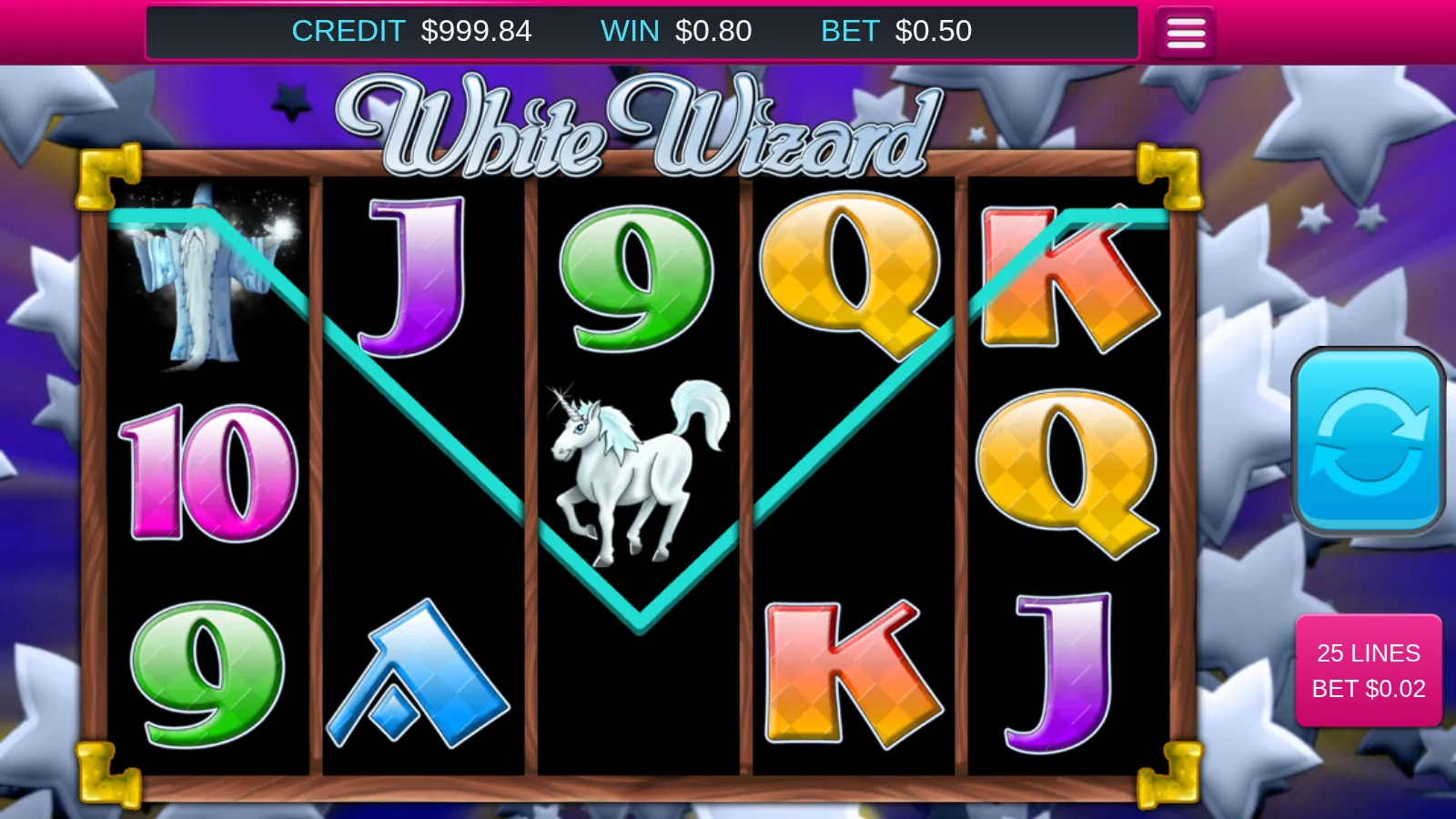
The return on White Wizard is 94.941%, the lowest figure anywhere in the studio’s classic range. Not an ideal start. The game spends that shortfall on a single symbol. Its Wizard substitute trebles every line it finishes, whereas the other Eyecon classics settle for doubling, and it is rationed to reels 1, 3, and 5. Free play is the cheapest way to watch those two rules pull against each other, because a treble is worth most on a five-symbol line, and the columns the Wizard skips are the ones a short win depends on.
The Wizard substitutes for every symbol other than the Dragon, and a winning line it joins pays at treble value rather than double. The reel restriction keeps that in check. Limited to reels 1, 3, and 5, the Wizard can be at either end of a win across the first three columns, but never in the middle of one, so the trebling attaches most often to the longer lines that already pay best. On a sheet whose top line tops out at 120x, that upgrade carries more weight than any other rule in the game. Outside the feature, the Wizard neither stacks nor holds, and it never covers a Dragon, so no wild can create a trigger.
Every Wizard swells to fill its whole reel once the free games begin, expanding as the line wins are drawn, so three columns can turn solid instead of showing one position each. The trigger sets the length of the round. Three Dragons award 15 games, four award 20, and five award 25, and a round may retrigger 15 times over. Dragons pay on their own as well, landing anywhere on the board and paying 2x, 5x, 15x, and 300x as they climb from two symbols to five. The feature runs on the same lines and wager as the round that opened it, so the expanding Wizards carry the whole of the upgrade.
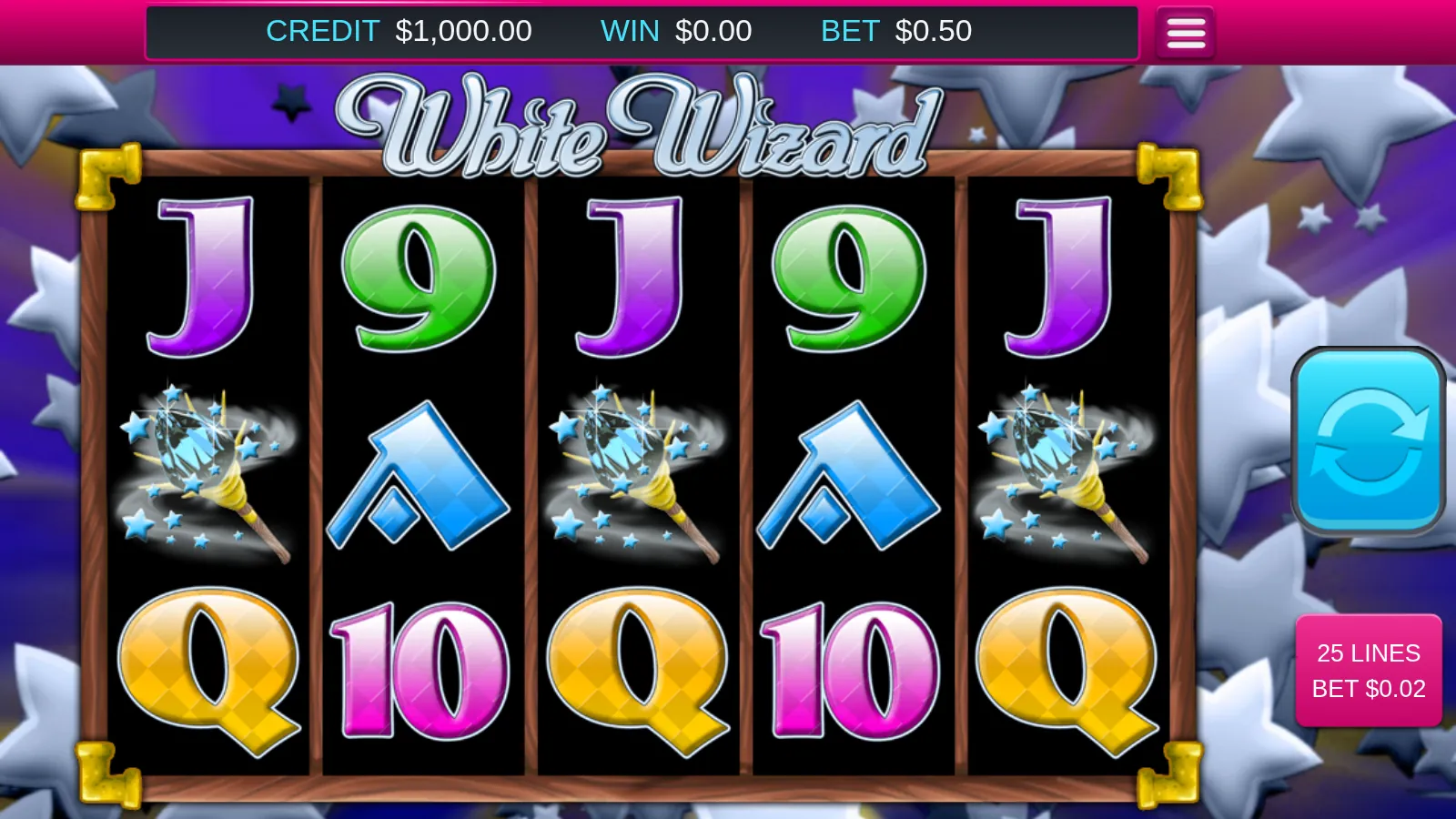
Twelve symbols run on the reels, and only six of them are drawn objects. A cauldron of green bubbles heads the line wins, the gold spellbook follows it, and the unicorn and the sparkling wand share third place. Below those, card royals in boiled-sweet colours fill most of the board on most spins, and the 2016 art reads thinner in motion than it does in a still frame. The backdrop is a purple night sky strewn with grey stars behind a wooden reel frame, plain enough that the blue Dragon and the white-bearded Wizard register at a glance. Set beside the newer magic-themed releases on the site, it is a modest piece of drawing, and it has aged better than the royals suggest.
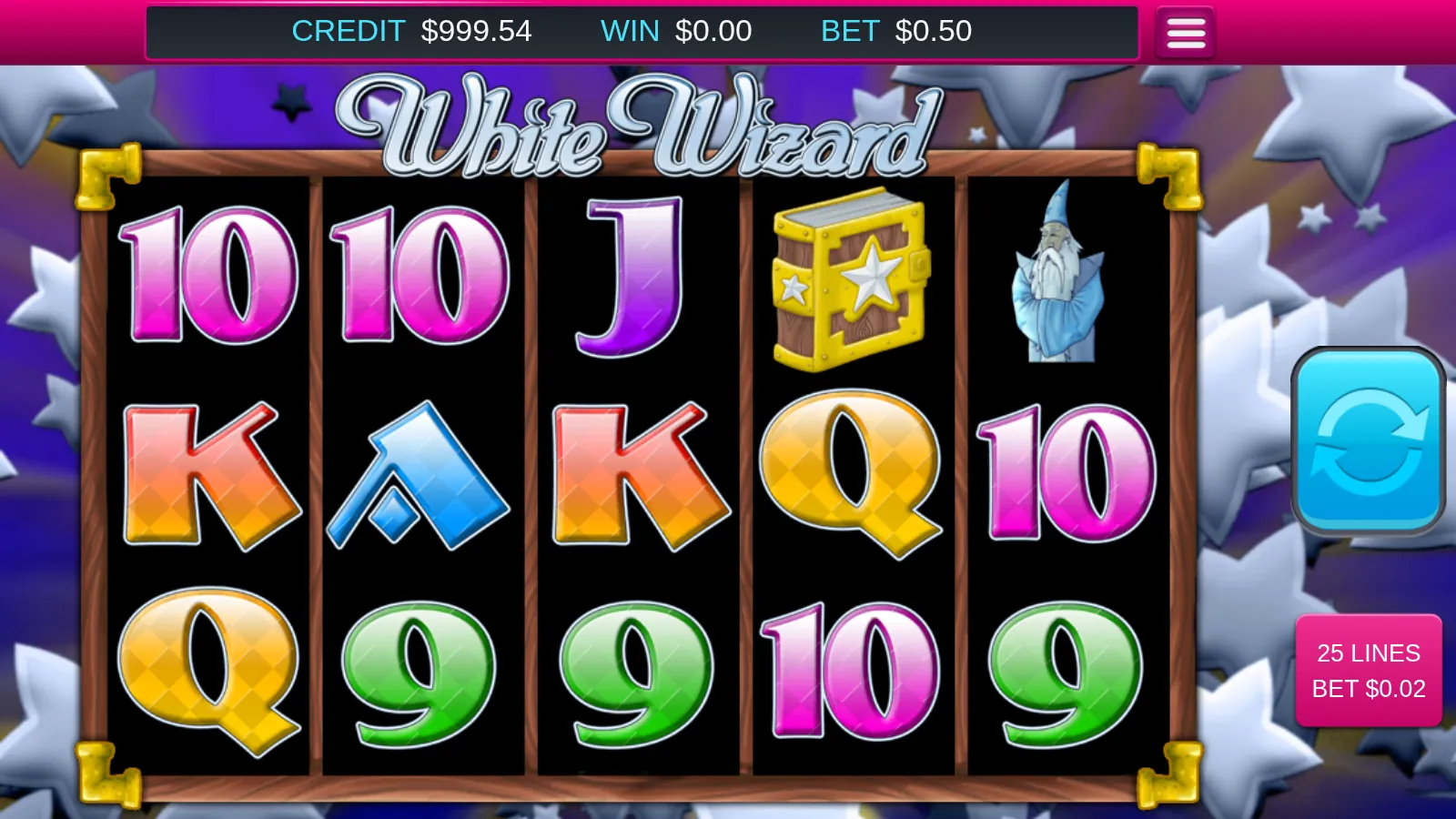
Most of what separates White Wizard from its stablemates happens in three columns. The Wizard reaches reels 1, 3, and 5 only, so a run of three matching symbols from the left can be topped up by a wild on the first or the third reel, while a four-symbol run can take one on reel 3 alone. Wins build rightwards from reel 1 across 25 fixed lines, each line keeps only its top win, and separate lines pay separately. Dragons ignore that map altogether. They pay from wherever they land, and their prizes are read against the whole stake rather than the wager riding on one line. That unit difference is what makes the scatter row read so much larger than the symbols above it. The site’s other wizard-themed line game, Blue Wizard, comes from a different studio, and it is worth a look before you decide which wild rule you prefer.
Free play returns 94.941%, the RTP the game’s own rules give. The 25 lines and the 15, 20, or 25 free games are standard issue across Eyecon’s classic range; the trebling wild is not. Eyecon rates the title high volatility itself, and the shape of the sheet supports that, with long flat stretches under the four objects and nothing to collect between features.
No maximum win is published for this game, so the largest number on the sheet is the Dragon’s 300x on five of a kind. Everything else climbs from the royals. The 9 and the 10 open at 0.12x for three and reach 4x on five of a kind, J and Q run 0.2x, 0.8x, and 8x, and K and A run 0.2x, 2x, and 20x. The wand and the unicorn share 0.4x, 4x, and 40x, the spellbook reaches 80x, and the cauldron tops the line wins at 120x. Those four objects are also the only symbols that pay from two, at 0.08x.
| Symbol | 2 | 3 | 4 | 5 |
|---|---|---|---|---|
| Cauldron | 0.08x | 1.2x | 12x | 120x |
| Spellbook | 0.08x | 0.8x | 8x | 80x |
| Unicorn | 0.08x | 0.4x | 4x | 40x |
| Wand | 0.08x | 0.4x | 4x | 40x |
| A | 0.2x | 2x | 20x | |
| K | 0.2x | 2x | 20x | |
| Q | 0.2x | 0.8x | 8x | |
| J | 0.2x | 0.8x | 8x | |
| 10 | 0.12x | 0.4x | 4x | |
| 9 | 0.12x | 0.4x | 4x | |
| Dragon (scatter) | 2x | 5x | 15x | 300x |
A trebling substitute on reels 1, 3, and 5 that opens into full reels once the feature starts gives White Wizard a wild rule no other Eyecon classic carries. The 94.941% return is the price, and it shows in a base sheet where the royals pay fractions and long gaps are normal.
Three out of five, because White Wizard buys the best wild rule among Eyecon’s classics with the weakest return in it, and those two facts look like one decision seen from either side.
94.941% is the number to start from. Every other build in this range measures above 95, and this one lands under the figure the studio advertises, which is unusual enough to be deliberate. What the game buys with it is a substitute that trebles rather than doubles, and the top figure on the sheet belongs to the Dragon rather than to any line at all. That combination makes free play here a stop-start affair, with the royals paying fractions of a bet and the real money sitting in two places that arrive rarely.
The case against the trebling is the reel map. With the Wizard confined to the odd reels, the wins it improves are mostly the ones that were already good, since a three-symbol line running from the left can only take a wild at one end or the other. A four-symbol run gets a single chance at it. Read coldly, the rule pays out most where the sheet needed help least, and a 25-line game whose 10 and 9 pay 0.12x for three needs help lower down.
Then, the free games arrive, and the argument turns. Expanding Wizards mean reels 1, 3, and 5 can each go solid, which is when the short lines finally benefit, and a retrigger cap of 15 gives the round room to grow. A feature that changes the wild’s behaviour rather than adding a multiplier or a spin count is rarer than it should be for this studio, and it is the one part of the design that feels thought-through rather than inherited.
What is left is a 2016 line slot with good bones and old clothes. The royals dominate the screen, the animation is minimal, and anyone who has worked through a few Eyecon titles will recognise the furniture immediately. White Wizard Deluxe exists for players who want the same idea with newer art. This review lands where the numbers do, on a game worth an hour for its wild rule and no longer than that for its return.