Mahjong Wins Triple Pot

Mahjong Wins Triple Pot Stats
Free Spins & Bonus
- Free Spins
- Random when a bonus coin is collected; 8 spins
Mahjong Wins Triple Pot Demo
A 97.00% RTP headlines the demo rules of Mahjong Wins Triple Pot, a full point above the studio’s usual mark, and it shares the page with a 100,000x win cap and a medium volatility badge. Pragmatic Play doesn’t usually let one slot carry all three. The catch, if there is one, lives in the three pots perched above the reels.
Three Pots, One Random Trigger
Triple Pot landed on 18 June 2026 as the newest of the Mahjong Wins slots, and anyone who’s played the Super Scatter or Black Scatter editions will recognise the furniture straight away. Same tiles, same animations, same pots sitting over the middle reels. What’s different is the economy underneath them, and that’s where the odd numbers start to make sense.
Gold Tiles and the Ingot Wild
On any spin, tiles across the middle three reels can land with a gold finish. Nothing happens until one of them wins. When a gold tile forms part of a winning combination, it converts into the ingot wild for the tumble that follows, so a single connected win can seed the next one. The wild stands in for every tile except the scatter coins and never reaches reels one or five.
The Tumble Trail
Winning tiles clear, survivors drop, and new symbols fall in from above until the board runs out of wins, the same falling-reels rhythm Pragmatic gives Monster Superlanche. A banner above the grid climbs from 1x to 2x, 3x and finally 5x as tumbles chain together, every win in the current tumble takes the live multiplier, and the trail resets once the board settles. During free spins, the ladder doubles up, running 2x, 4x, 6x and 10x.
Coins, Pots and the Random Trigger
Blue, red, and purple coins fall on reels two, three, and four, respectively, each stamped with a value between 10x and the full 100,000x. Land one and it’s whisked into the matching pot above its reel, but the number printed on it stays out of reach. Coin values can’t be credited during regular spins. Collecting one simply gives the game a chance to fire the free spins feature at random, with one, two or three pots chosen as active, and when that happens, the values of every coin involved in the trigger are paid immediately, and eight free spins begin.
Golden Reels and the 100,000x Cap
Each active pot turns its reel gold for the whole round, so everything landing there arrives gold-marked and ready to convert. Coins can still drop on reels that weren’t part of the trigger, and when one of those collections randomly retriggers the feature, you get two extra spins and another golden reel for the rest of the round. Once all three reels are active, coins stop appearing altogether, and the round becomes pure tumbling under the 10x trail. Should a round’s running total reach 100,000x, it ends immediately, with the full amount credited and any remaining spins forfeited.
How to Play
Mahjong Wins Triple Pot stacks its grid unevenly, four rows tall on the outer reels and five across the middle three, and that shape is exactly where the 2,000 ways figure comes from. It also tells you where to look. Wilds, gold marks and bonus coins are all confined to reels two, three and four, so the tallest columns are the ones doing the work.
Ways connect left to right from the first reel, with adjacent reels only, and the strongest win pays per way, with separate ways added together. If you’ve spun the 5 Lions Megaways demo, reading the wins will feel familiar, though the ways count here is fixed, with no reshuffle between spins. Stakes run from $0.25 to $250, set through a plus-and-minus menu that also exposes coin value for anyone who builds bets the old way. Space and Enter start and stop the reels, Turbo hides behind a held Spacebar, and Autoplay includes a skip-screens option. There’s no bonus buy and no ante bet anywhere in the game, a rare omission for a Pragmatic tumbler, which leaves every route to the feature in the hands of the random coin trigger. Free play starts you on a $100,000 demo balance.
Mahjong Wins Triple Pot Paytable
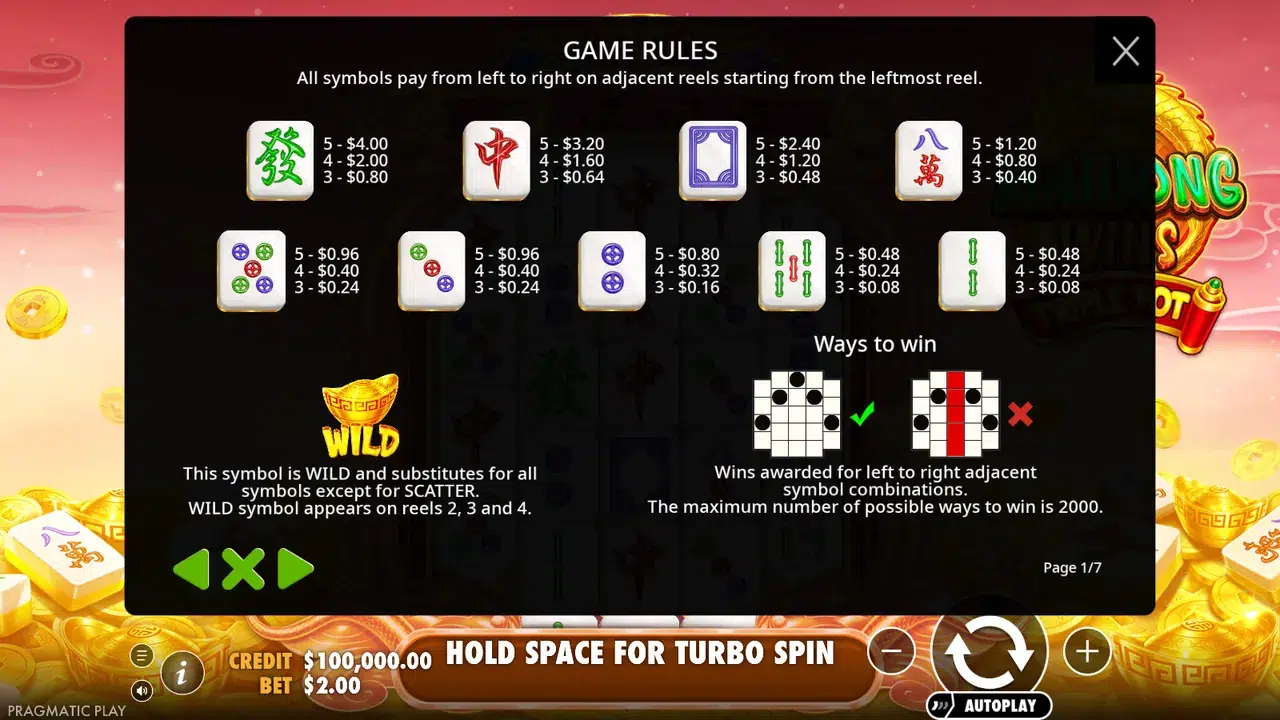
Recorded at a $2.00 stake and converted to bet multiples, the board tops out modestly. The green Fa tile is the best of the nine, and a full five-reel way of it returns twice the bet.
| Symbol | 3 of a kind | 4 of a kind | 5 of a kind |
|---|---|---|---|
| Green Fa tile | 0.40x | 1.00x | 2.00x |
| Red Zhong tile | 0.32x | 0.80x | 1.60x |
| Blue-framed tile | 0.24x | 0.60x | 1.20x |
| Eight of Characters | 0.20x | 0.40x | 0.60x |
| Five of Circles | 0.12x | 0.20x | 0.48x |
| Three of Circles | 0.12x | 0.20x | 0.48x |
| Two of Circles | 0.08x | 0.16x | 0.40x |
| Five of Bamboo | 0.04x | 0.12x | 0.24x |
| Two of Bamboo | 0.04x | 0.12x | 0.24x |
The ingot wild carries no value of its own, and the coins pay nothing as symbols; both exist for the features they enable.
Ultimate Slots Verdict
Steady-session players are who this slot was built for, with a 97.00% demo return, busy tumbles and a medium badge that tells the truth about the tile wins. The 100,000x headline is real but pays only through a randomly fired coin trigger nothing can influence, above pots that are, by the rules' own admission, decorative.
Hits What we like
- The demo build runs a 97.00% theoretical return, a full point above Pragmatic's usual setting
- Tumble multiplier trail reaches 5x in regular play and 10x during free spins
- Winning gold tiles leave ingot wilds behind, so one connected win can chain into the next drop
- Retriggers strengthen the round as it goes, each adding two spins and a fully golden reel
- Coin values up to 100,000x are paid in full the instant a trigger or retrigger fires
- The medium badge matches how the tile wins actually behave, so the ride is as advertised
Misses What could be better
- Coin values are inert in the base game and the tumble multiplier never touches them
- No bonus buy and no ante bet, so feature frequency is entirely out of your hands
- Pot-fill animations imply progress that the small print disowns
- Recycles the series' tiles and animations wholesale, so it barely reads as a new game
Detailed Review
Behind the Pot Theatre
Numbers this friendly usually mean a catch somewhere, and finding it was the point of this review. Most third-party listings file the Mahjong Wins games under high volatility, yet the rules pages here insist on medium, backing the 3/5 badge with a plain statement that pays arrive steadily across a wide range. Both descriptions turn out to be true, depending on which half of the game you’re watching.
The tile wins are the medium half. A full way of the best symbol returns twice the bet, the tumble trail tops out at 5x between features, and together they produce the modest, regular rhythm the badge promises. The 100,000x tail lives entirely in the coins, and the design quarantines it with real care. Coin values can’t be credited during ordinary spins. The tumble multiplier never applies to them. They pay only when a collection randomly fires a trigger or retrigger, which walls the headline number inside an event no decision of yours can reach.
The pots, meanwhile, are decoration.
Pragmatic’s own rules say so in as many words, calling the pot collections a graphic representation for entertainment purposes only. Our capture spins bore that out. A red coin dropped onto reel three, chimed into its pot, and the game moved on without paying a cent, exactly as written. The fill animation still works on you, though. Watching a pot swell spin after spin manufactures a sense of progress toward a trigger that the maths never promised, and the gap between what the eye reads and what the game admits in print is the most manipulative thing in an otherwise transparent design.
Pragmatic Play Comparison
Players who want agency should know what they’re giving up here. There’s no buy, no ante, no scatter count to build toward, and where Sugar Rush’s sticky multiplier spots make progress within a spin real and visible, nothing you watch in Triple Pot moves you closer to anything. A cap reachable only through a random event has more in common with a lottery ticket than with anything you could plan around, and the medium badge describes the everyday ride rather than that tail. Anyone arriving from earlier Mahjong Wins games should also temper expectations on presentation, because visually this adds almost nothing new to the series.
So, is a 97.00% return under a 100,000x cap too good to be true? No, but neither number means quite what it seems. The return is real and worth having, the cap is real and kept deliberately out of reach, and the pots between them are stagecraft. Enjoy the friendly maths and the busy tumbles, and let the pots be what the rules already told you they are.