Forge of Olympus
Forge of Olympus Stats
RTP & Maths
- RTP by Mode
- Ante Bet 96.23 · Buy Free Spins 100x 96.42 · Buy Free Spins 200x 96.70 · Buy Free Spins 400x 96.32 · Buy Free Spins 500x 96.32
- RTP Versions
- 96.25% here · also certified at 95.04%, 93.96%
- Max Win Rule
- applies in base and feature
Free Spins & Bonus
- Free Spins
- 4/5/6 scatters = 10/15/20 free spins · 10-20 spins · retrigger: 3 or more scatters during the round award 5 additional free spins
- Bonus Buy
- Start from Level 1 100x (96.42% RTP) · Start from Level 2 200x (96.7% RTP) · Start from Level 3 400x (96.32% RTP) · Start from Level 4 500x (96.32% RTP)
- Ante Bet
- 1.25x stake · Doubles the chance to win free spins naturally and puts more SCATTER symbols on the reels; disables the Buy Free Spins feature · disables the buy
- Multipliers
- 2x-100x · add
Symbols & Pays
- Wild
- none
- Scatter Reels
- all reels, pays on any position
- Line Pays
- top symbol 50x · lowest 0.25x
Forge of Olympus Demo Slot
Forge of Olympus prices its free spins four ways, and the cheapest isn’t the best value. The 100x buy returns 96.42%, the 200x buy returns 96.70%, and the two expensive entries at 400x and 500x both fall back to 96.32%. That makes the 200x option the highest-returning mode in the game, standard play included, which is not how a buy ladder normally reads. Around those numbers is Hephaestus at his anvil, a 6×5 grid of lava and bronze, tumbling wins, and multiplier orbs that add up rather than replace one another. The demo opens every mode of this Pragmatic Play slot in free play.
Gameplay Options
Tumbles and Orbs
Winning symbols vanish once they’ve paid, the survivors fall to the bottom, and fresh symbols drop in from above. Tumbling carries on until a spin stops producing wins, with no limit on how many times it repeats. The multiplier orb is the reason long sequences matter. It takes a random value from 2x to 100x, it can land in standard play or within free spins, and when the sequence ends, the game adds every orb value on screen together and multiplies the sequence win by that total. Two orbs beat one, and a slow sequence that keeps going beats a fast one that pays immediately.
Free Spins Levels
Ten free spins follow four scatters, 15 follow five, and 20 follow six. Three or more scatters during the round add another five spins on top, with no stated limit on how often that can happen. The round then runs a level meter fed by the orbs you collect. Six orbs promote it to the second level, another five to the third, and another four to the fourth, and every promotion raises the floor of the orb range while leaving the top of it alone. The fourth level is the end of the ladder, and the remaining spins all play there.
The Buy Ladder
The four purchases buy starting levels rather than different rounds. The cheapest opens free spins at the first level with the orb range at its lowest floor, and each step up starts the round one level further along, so the most expensive option begins with every orb already worth a heavy multiple. The return figures are the argument against climbing that ladder for its own sake. Any purchase can also drop extra scatters onto its triggering spin, which lengthens the round before it has started.
Double Chance
The plaque on the left rail raises the stake by a quarter, to 1.25x. It doubles the chance of triggering free spins naturally and puts more scatters on the reels, and it switches the purchase off completely while it’s active. You take one route into the feature or the other, never both.
The Gates Lineage
This is the Gates of Olympus format with one part swapped out. Both games pay by count on a six-reel grid, both tumble, and both hand the upside to multiplier symbols. Gates pulls its multipliers from a single random pool. The forge tiers them instead, lifting the floor as the round progresses, so a long free spins round is worth more than a lucky one. Gates of Hades took the same engine and priced two separate modes apart; this one keeps a single round and prices the entry points into it.
How to Play
A Popular Pay Anywhere Slot
There are no lines to follow. Eight or more of the same symbol anywhere on the 6×5 grid makes a win, and the count alone decides the value, so where the symbols land never matters. That makes the board read differently from a line game. You’re counting rather than tracing, and a scattered screen pays exactly as well as a stacked one. The paying set runs from four gems at the bottom through the topaz triangle, the ring, the chalice, and the helmet to the medusa shield at the top, with the scatter and the multiplier orb outside the count. Tumbling means one spin can produce several wins in sequence, and the balance updates only after the last of them has resolved.
Gameplay Stakes and Payouts
The demo starts at $0.20 and standard play returns 96.25%. Our own tier agrees with the High the rules give it, which makes the badge unusually honest for this provider. Bet steps come from the game’s own bet menu, and the Buy Free Spins button reprices all four options against whatever total bet is showing, so the ladder scales with the stake rather than holding fixed cash prices.
Symbol Payouts
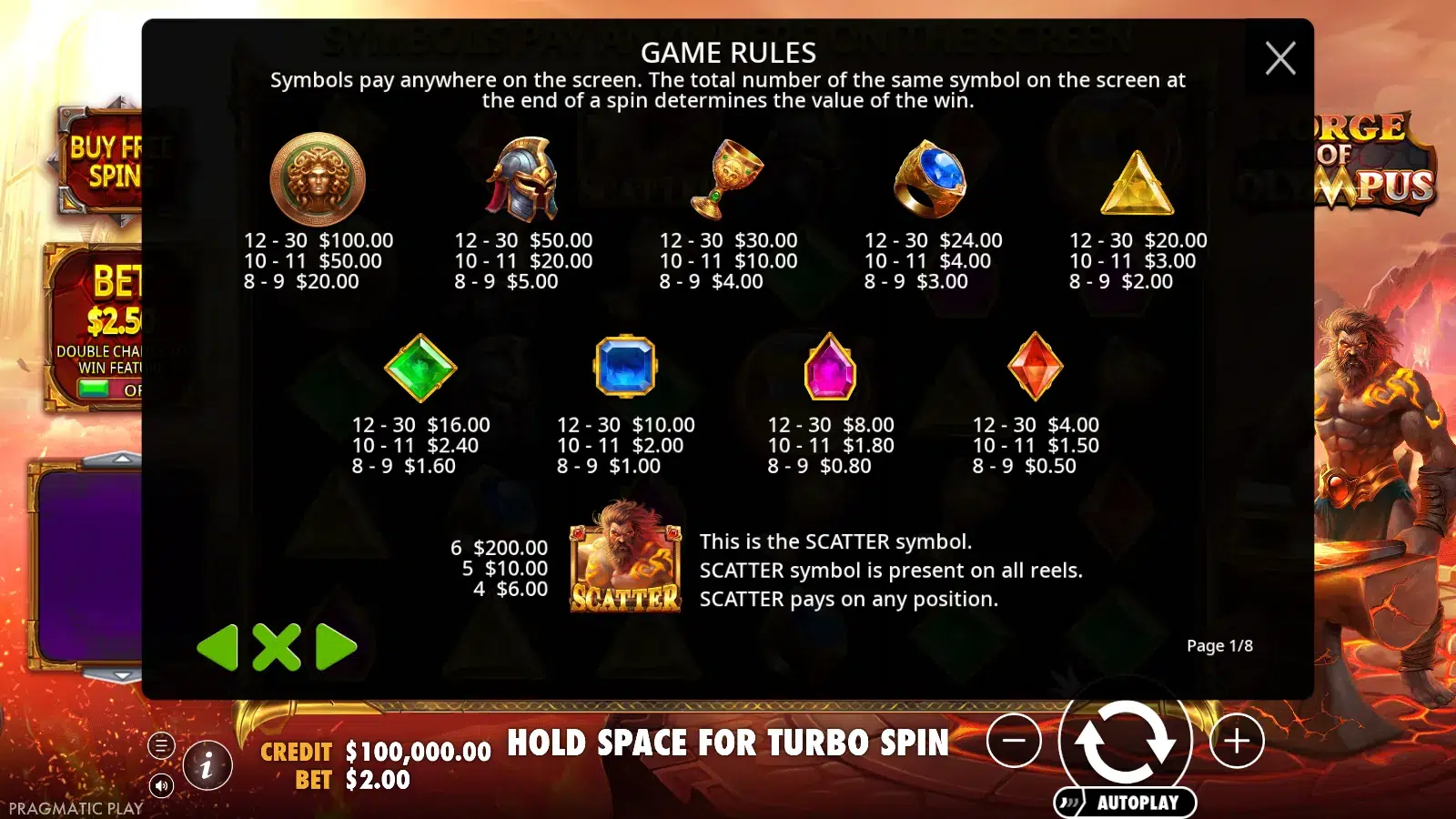
The table shows each symbol’s stake multiples across the three count bands the game uses. Wins of 12 or more all share one top band, and the medusa shield’s 50x is the largest single-symbol payout on the grid.
| Symbol | 8–9 | 10–11 | 12+ |
|---|---|---|---|
| Medusa shield | 10x | 25x | 50x |
| Helmet | 2.5x | 10x | 25x |
| Chalice | 2x | 5x | 15x |
| Ring | 1.5x | 2x | 12x |
| Topaz triangle | 1x | 1.5x | 10x |
| Green gem | 0.8x | 1.2x | 8x |
| Blue gem | 0.5x | 1x | 5x |
| Pink gem | 0.4x | 0.9x | 4x |
| Red gem | 0.25x | 0.75x | 2x |
| Scatter (4 / 5 / 6) | 3x | 5x | 100x |
The red gem’s lowest band pays a quarter of the bet, which is the smallest win the grid can produce, and the gap between that and the shield’s top band is the whole reason the orbs carry the game.
Ultimate Slots Verdict
The tidiest thing Pragmatic has built on the Gates format, and the only one where the return table tells you what to do. The mid-priced buy beating standard play is a real edge, the tiered orbs make a long round worth more than a lucky one, and the missing wild costs less than it sounds like it should. High volatility, priced with unusual clarity.
✓ What We Like
- The mid-priced buy returns more than standard play, which almost no buy ladder does
- Multiplier orbs add together rather than replacing each other, so long tumble sequences compound
- Every free spins promotion lifts the floor of the orb range, rewarding rounds that last
- Scatters pay on their own, and the six-scatter tier is a substantial payout by itself
- Counting symbols instead of tracing lines makes every board readable at a glance
✗ What Could Be Better
- No wild symbol anywhere, in standard play or within the feature
- The two most expensive purchases cost more and return less than the 200x one
- Double Chance and the purchase cancel each other out, so only one route into free spins is available at a time
Detailed Review
How Our Gameplay Went
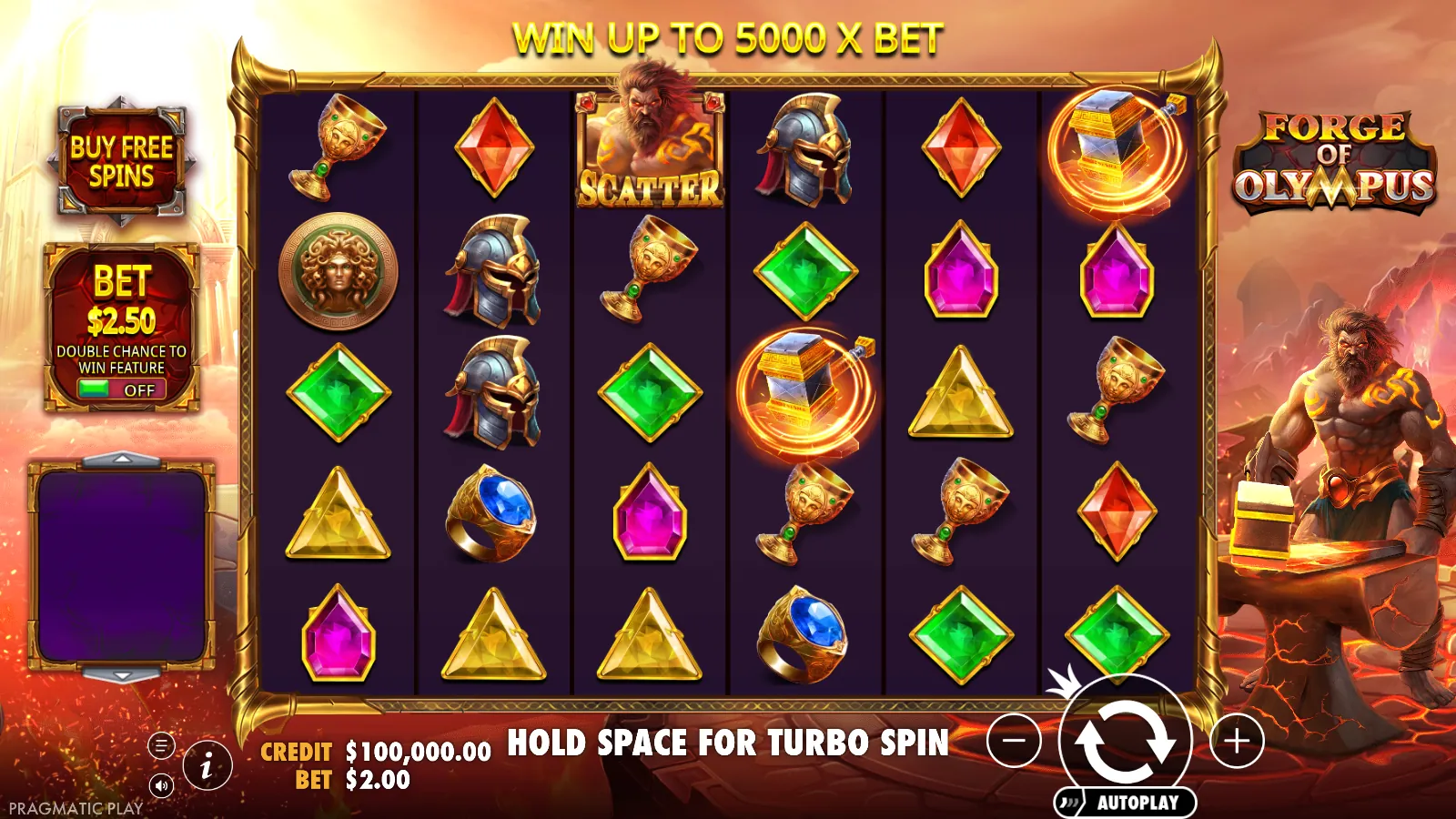
A board of gems and medusa shields with one scatter on it and an empty orb panel on the left rail is the ordinary state of this game. Nothing is tumbling, nothing is multiplying, and the shields are short of a paying count. Forge of Olympus spends most of its time exactly there, which is what a high-volatility tumble slot looks like when it isn’t paying.
The number that makes this page worth writing is the shape of the buy ladder. Buy prices normally climb with return, or at least track it. Here, the second rung outperforms both rungs above it and standard play as well. The expensive purchases are buying a shorter route to a high orb band, not a better deal, and anyone who buys once and buys in the middle is taking the best-returning option the game offers.
The second oddity is what the game leaves out. There’s no wild symbol here, in standard play or within free spins. On a pay-anywhere grid, a wild would substitute across an entire screen rather than a single line, so removing it is a real design decision and not an oversight. The result is cold but honest. Every win comes from symbols that actually landed, nothing on the grid stands in for anything else, and the orbs are left to supply all the upside the format has.
The forge itself is the best of the presentation. Lava light moves under a bronze frame, the anvil work carries the sound, and the level meter is the only part of the display that changes state while you watch. The rules then put a hard stop on all of it: “The maximum win amount is limited to 5,000x bet.” Against an orb band reaching 100x, that limit is closer than it looks on a good sequence, and it’s the reason this game feels tighter than its relatives do.
Four prices, one of them returning more than standard play, and a level meter that tells you where the round is. Forge of Olympus asks a question most tumble slots never bother to ask, and it answers it in its own numbers rather than leaving the reader to guess.