Gates of Hades

Gates of Hades Stats
RTP & Maths
- RTP by Mode
- Base 96.52% · Buy Free Spins 96.50% · Buy Super Free Spins 96.47%
- Jackpots
- None
Free Spins & Bonus
- Free Spins
- 3/4/5/6+ scatters = 10/12/15/20 spins; retrigger +5/7/10/12
- Bonus Buy
- Buy Free Spins 100x total bet; Buy Super Free Spins 500x total bet (10x minimum wild multiplier). Both guarantee 3-6 scatters on the triggering spin.
Hades’ Confusing Bonus Buy
Would you pay five times the price for a slightly worse return? That’s the arithmetic on the left rail of Gates of Hades, a 6×6 cluster slot where two stone tablets sell two ways into the same bonus round. Buy Free Spins asks 100x your stake and runs at 96.50%. Buy Super Free Spins costs 500x your stake and runs at 96.47%. Standard play sits above both at 96.52%, leaving the most expensive button on screen paying out the least.
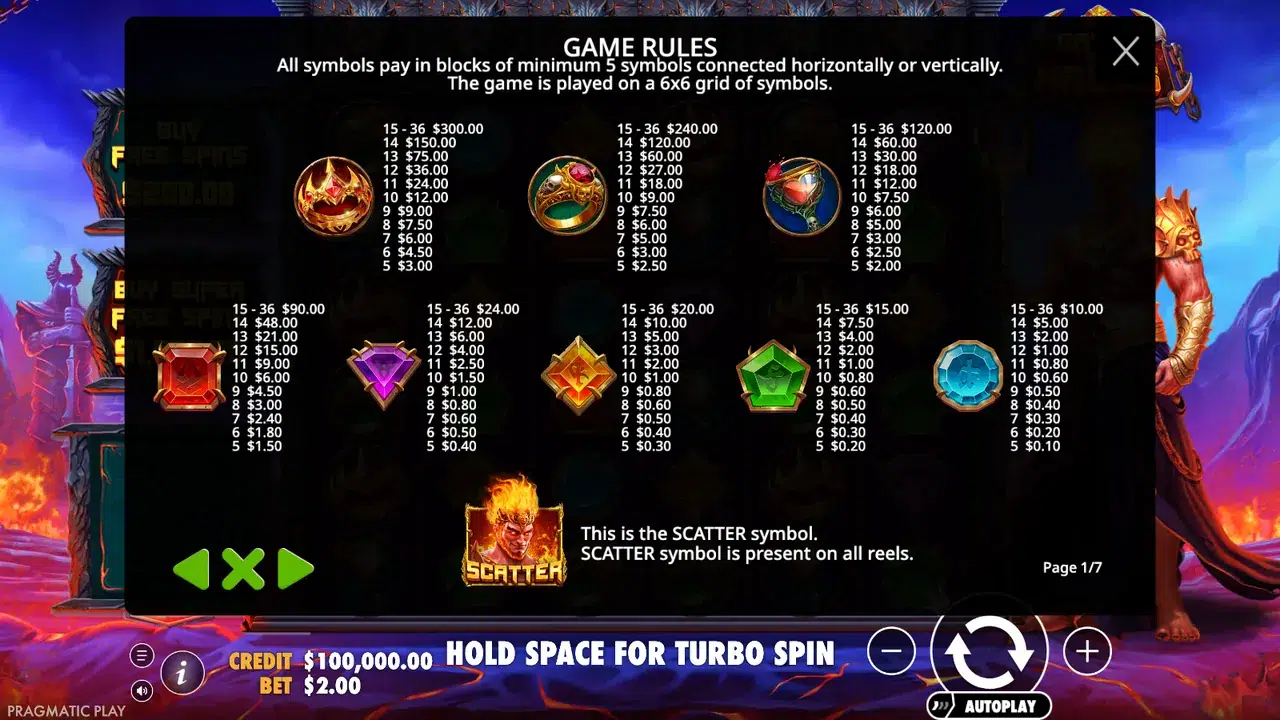
Pragmatic Play prints all three figures on one rules page, so it’s not exactly hidden, and working out why they differ tells you what this game actually is.
Pragmatic released it on 22 May 2025, a month after Gates of Olympus Super Scatter, so one Greek Gods series put two structurally different games into the mythology catalogue inside five weeks.
What Feeds the Meters
The 6×6 Grid and the Five-Symbol Rule
The opening rules page is blunt about how wins form. “All symbols pay in blocks of minimum 5 symbols connected horizontally or vertically. The game is played on a 6×6 grid of symbols.” Thirty-six positions, no lines, and no pays-anywhere counting. Five matching symbols must touch edge to edge, up and down or side to side, before anything pays. Diagonal contact does nothing. That single rule separates this game from the family it’s marketed into, and it changes what a good board looks like — clumps beat spread.
Winning symbols vanish, everything above them drops into the gap, fresh symbols fill from the top, and the tumbling carries on until a drop produces nothing. There’s no limit on how many times that repeats, and every win from the whole sequence arrives in the balance together once it stops.
Wild Meters That Sit Above the Columns
Every wild carries a random multiplier, drawn from 1x through 10x, then 15x, 20x, 25x, 30x, 50x, and 100x. What happens next is where most descriptions of this game go astray.
The value doesn’t attach to the symbol, and it doesn’t attach to the win it helped make. It climbs into a glowing meter set into the row of carved stone heads above the column the wild landed on, and it stays there.
When a block pays, the game adds up the meters standing over every column that block touches and multiplies the win by that total. A block spanning three columns carrying 6x, 4x and 25x is multiplied by 35, not by 600.
Free Spins, and the Sixth Scatter
Three, four, five or six-plus Hades scatters award 10, 12, 15 or 20 free spins. Land six or more and the round upgrades to Super Free Spins, where no wild can carry less than 10x and the multiplier pool stretches to 200x and 500x. Retriggers run the same ladder for 5, 7, 10 and 12 extra spins.
The rule that matters more than any of those numbers is the clearing rule. Outside the bonus, the reel meters wipe to zero as soon as a spin’s tumbles finish. Inside free spins, they never wipe. Every wild that lands for the whole round stacks its value onto whichever column caught it, so a feature that opens on six empty meters can be sitting on four loaded ones by the tenth spin.
The Two Stone Tablets
Buy Free Spins costs 100x total bet and guarantees three to six scatters on the triggering spin, with the ladder deciding the length as usual.
Buy Super Free Spins costs 500x and does the same with the 10x wild floor switched on. At the $2.00 stake, those tablets read $200.00 and $1,000.00, and they held those prices throughout. The certified returns behind them, 96.50% and 96.47% against 96.52% for ordinary spins, sit on the same rules page as the game’s headline RTP. It’s a small difference, but it’s a difference nonetheless.
The 10,000x cap applies to standard play and the feature alike. Reach it mid-round, and the game pays out and closes the round there, forfeiting whatever spins were still owed.
How to Play
Reading the Board
The five-symbol block rule is the first thing to internalise. Four crowns in a neat square pay nothing; the same four with a fifth crown touching any of their edges pay. That makes the middle columns worth more attention than the outer two, since a block growing sideways out of column three has more grid to grow into, and it makes a tall vertical run of six the cheapest shape a win can take.
Stakes in the demo run from $0.20 to $240.00 a spin, set on the plus and minus controls at bottom right. Holding the spacebar switches to turbo, autoplay sits beside the bet controls, and the two buy tablets are parked left of the grid where they’re impossible to miss. Free play makes the top of that range explorable, and the shape of the game doesn’t change with the stake, only what the meters are multiplying.
What a Five-Symbol Block Is Worth
Values below are multiples of total bet, read off the paytable at the $2.00 stake. Blocks of 15 or more all pay the same top tier, which is where the table stops. The wild carries a single entry of its own, worth 150x, and only when it fills all thirty-six positions.
| Symbol | 5 | 10 | 14 | 15–36 |
|---|---|---|---|---|
| Crown medallion | 1.5x | 6x | 75x | 150x |
| Gem ring | 1.25x | 4.5x | 60x | 120x |
| Heart charm | 1x | 3.75x | 30x | 60x |
| Red gem | 0.75x | 3x | 24x | 45x |
| Purple diamond | 0.2x | 0.75x | 6x | 12x |
| Orange diamond | 0.15x | 0.5x | 5x | 10x |
| Green pentagon gem | 0.1x | 0.4x | 3.75x | 7.5x |
| Blue round gem | 0.05x | 0.3x | 2.5x | 5x |
The gap between the four high symbols and the four gems is the steepest part of the design. A twelve-symbol block of blue gems returns half a stake; the same block in crown medallions returns eighteen times it.
Ultimate Slots Verdict
Persistent per-column multiplier meters are what this game has that the rest of the family doesn't, and they are strong enough to carry it on their own. A free spins round works as one continuous build, where every wild that lands makes every later block on that column worth more, while ordinary spinning, with the meters wiped after each tumble sequence, is a wait of roughly 270 spins for the privilege.
✓ What We Like
- Wild multipliers bank into per-column meters that hold their values for an entire free spins round, so a bonus builds instead of restarting
- A true cluster board on 6x6, with the five-connected rule stated word for word on the opening rules page
- Six or more scatters upgrade the round to Super Free Spins and put a 10x floor under every wild that lands
- A base hit rate near 29% keeps ordinary spinning ticking over between features
- The 200x and 500x wild values exist only inside the feature, giving the round a top end nothing outside it can reach
- Violet and magma art that walks a long way from the marble this family usually trades in
✗ What Could Be Better
- Free spins arrive roughly once in 270 spins, and the meters only matter once they do
- Buy Super Free Spins costs five times the standard buy and certifies three basis points lower
- The four high symbols pay several times what the four gems do, so most blocks resolve small
- No ante bet and no second feature, which leaves nothing to work towards between bonuses
Detailed Review
Playing Gates of Hades on the Numbers
The art makes the first argument. Violet light over cracked, glowing ground, a horned Hades in gold armour beside the grid, a three-headed hound on the splash screen. Pragmatic’s Greek output has been marble and blue sky for four years, and this breaks from it. The board sits low beneath a row of carved stone heads, exactly where the multiplier meters appear, so the decoration and the interface are the same object.
What sits under that art has been widely misreported, and this review mostly sets it straight. Coverage of this game routinely describes the Olympus pay system, because the family resemblance does exactly the work the marketing wants. Wins here need five matching symbols in physical contact, horizontally or vertically, and the rules page says the first you meet counts. Gates of Olympus 1000 and the rest of that line count eight or more of a kind wherever they fall, anywhere on the board. Different distribution entirely.
Follow a Super Free Spins round through, and the system explains itself. It opens with six empty meters and a guarantee that no wild can land below 10x. A wild drops on column two carrying 15x, and column two’s meter reads 15. Nothing else pays and nothing resets.
Outside the bonus, that value would be gone once the tumbles finished; here it stays. Two spins later a 10x wild lands on column five and a 30x wild on column two, so the meters read 45 and 10, values on one column adding together exactly as values across columns do. A block of nine crown medallions then forms across columns two, three and five. Column three has never held a wild, so it adds nothing. The block pays its 4.5x tier multiplied by 55, which is 247.5x the stake, and the crowns clear. The meters don’t. Five spins further on, with 100x banked over column one and column two past 80, that identical nine-crown block would pay 4.5x multiplied by more than 180, comfortably over 800x. The block hasn’t changed. The round underneath it has, which is why the length of a Super Free Spins round matters more than the size of any single wild in it.
Which brings the left rail back into focus. Both tablets open the same feature, at 100x and 500x, certified at 96.50% and 96.47% against 96.52% for ordinary spins. Paying five times more for three basis points less looks like an error until you see what the 500x buys. It buys shape. A 10x floor under every wild for the whole round, compounding across every column and every spin left. Neither tablet buys an edge, and the panel prints the numbers to prove it.
The cost is that ordinary spinning is a holding pattern. Wins land often, close to 29% of spins, but the meters wipe after every tumble sequence, so nothing accumulates. Watching a 50x wild pay once and disappear is a particular kind of deflation. The game shows you its best idea, then takes it away roughly 269 times in 270.
So does the family name tell you what you’re buying? Not here. The Zeus vs Hades slot shares the underworld and nothing else, and the Olympus line it’s filed under runs a pay system it doesn’t use. What Gates of Hades has is a bonus built on persistence and priced two ways, and the Greek Gods banner hasn’t shipped a more interesting piece of maths. Anyone who needs something happening between features is better served elsewhere in the series.