


Fruity Burst 2
Fruity Burst 2 Stats
RTP & Maths
- RTP Versions
- 93.04% here · Other versions 95 / 93 certified builds; the demo runs the lower 93 build, printed in game as 93.047
Free Spins & Bonus
- Free Spins
- 3 or more scattered Bonusball symbols after cascades stop in standard play · Not stated; Free Games run until one or more cascades occur on the 8x8 grid · Retrigger: not stated; PowerUpball scatters step the grid up instead
Symbols & Pays
- Scatter Reels
- Scattered anywhere; Bonusball in the base game only, PowerUpball in Free Games only and not on the 8x8 grid
- Cluster Pays
- Top symbol 10,000x · Lowest 0.4x
Fruity Burst 2 Basics
Free games start on the same 5×5 board as everything before them, then widen. Land a PowerUpball once the cascades stop, and the next free game runs on 6×6. Land another, and it becomes 7×7, then 8×8, and the round finishes on 64 positions. The grid grows every time that feature fires. The return does not grow with it. Eyecon publishes this cluster slot at two return settings, and the demo here runs at 93.047%.
How the Demo Works
Clusters and Cascades
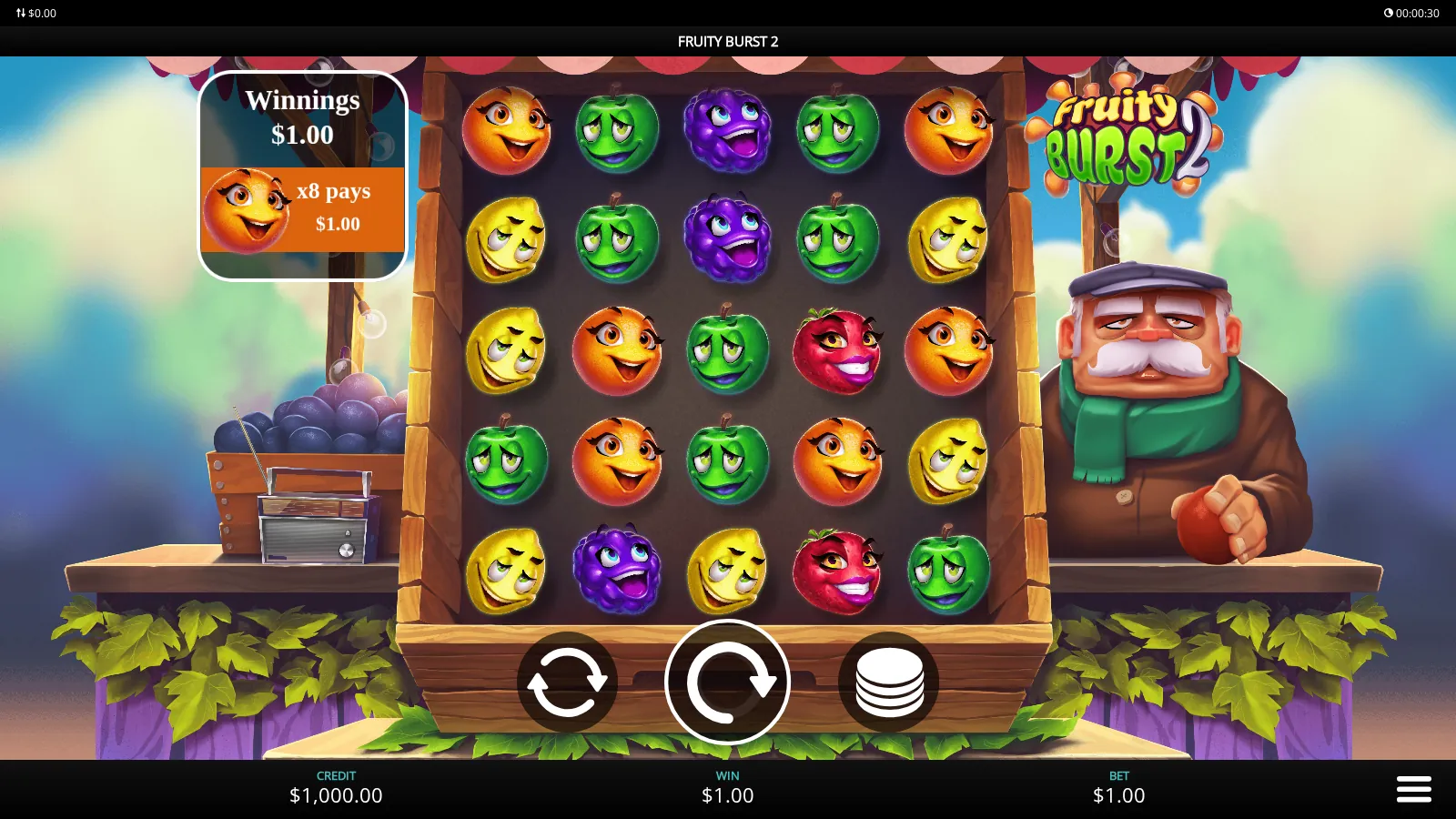
Wins form when five or more of the same fruit link up, side by side or one above another. A corner touch does nothing on its own. Every cluster on the grid is paid; the winning fruit burst and vanish; whatever sat above them drops into the gap, and new fruit fills the rest of the board. The grid is then read again. Cascades keep running until a drop leaves nothing linked, so a single paid spin can settle three or four times before the counter stops. Only the highest win counts on each cluster, and the game adds separate clusters together.
The Bonusball
One scatter belongs to standard play. The Bonusball wears a FREE GAMES splat, never joins a cluster, and pays 1x when three or more of them land. Those three are counted after the cascades have finished, not while they are still resolving, so a board that looks like a trigger can still lose one to a falling win. Three or more open the free games. The Bonusball then stops appearing, and the second scatter takes over.
Free Games and the Powergrid
The round opens on 5×5 at the wager that triggered it. Then, the PowerUpball arrives. One landing after the cascades stop steps the board up a size for the next free game, from 5×5 to 6×6, then 7×7, then 8×8. That is the Powergrid Feature, and Eyecon brought it across from Bouncy Balls 2. Each step is worth having, because a wider board gives a cluster more room to link and a cascade more symbols to fill the gaps. The PowerUpball pays 1x whenever it lands, and it stops appearing once 8×8 is reached.
The 8×8 Finish
The round does not run to a spin count. No number of free games is given anywhere. Play continues on each board size until the Powergrid steps it up, and once 8×8 arrives, the round stays there until a cluster lands. One or more cascades on the 8×8 grid ends the feature. A player who never sees a PowerUpball can be on 5×5 for a long stretch, and a player who collects them quickly reaches the widest board with the round already close to over.
No Wild Anywhere
The help describes no wild. Six fruits pay, two scatters do their jobs, and nothing substitutes for anything else. Cluster games usually carry a wild to knit a near miss into a paying group, and the absence is felt most on the wide boards, where five linked fruit out of 64 positions is a low bar but a broken run has nothing to repair it. What the game offers instead is volume. The ladder starts paying out at 5, and the smallest cluster on the cheapest fruit still returns 0.4x.
The Market Stall
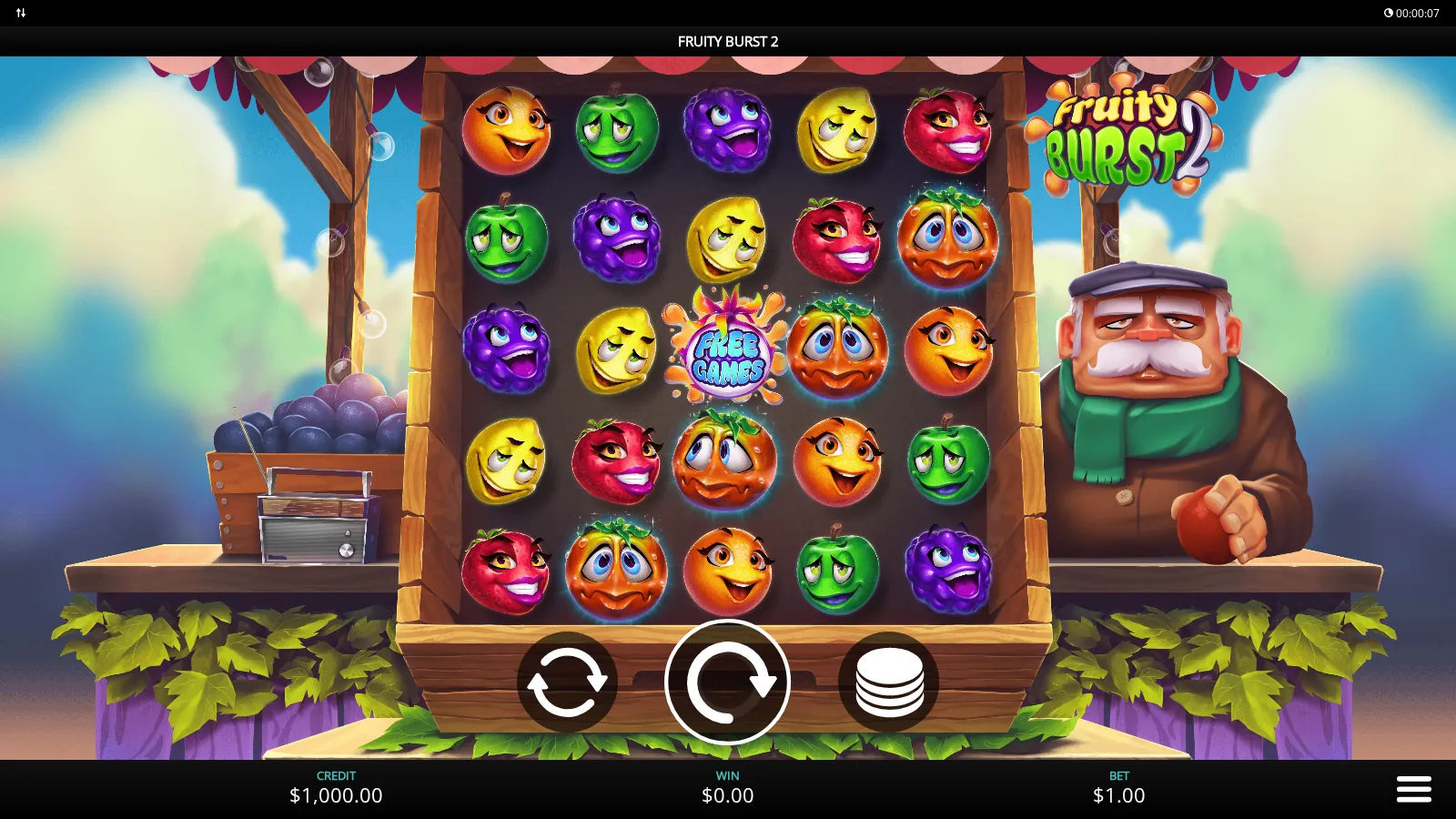
The board stands in a wooden fruit stall under bunting, with a moustached grocer leaning on the counter and turning an apple over in his hand. A radio and a crate of blackberries stand beside him. Every fruit has eyes and a mouth, and the glowing tomato is drawn as the odd one out, brighter than the rest and rimmed with light. It is a cheerful 2022 cartoon with no darker register to it, and the stall is a long way from the plush toys and leprechauns that fill most of Eyecon’s catalogue.
How to Play
Linked Fruit and RTP
Five matching fruit touching in a line, across or down, is the smallest group that pays, and a diagonal corner counts for nothing unless the chain connects straight. Coverage of the board is what to watch rather than any row or column, because there are no lines here to hold a win in place. The cascade engine underneath is the one Eyecon built for Bouncy Balls Cascade Crazy, and it shares nothing with the 25-line classics the studio is better known for. No fixed lines, no substitute symbol, no 15-game retrigger cap.
Eyecon states no minimum or maximum bet figure on this shell. The RTP comes in two settings Eyecon publishes, 95% and 93%, and the demo uses the lower of them at 93.047%. The studio’s own volatility rating for it is low, and the orange’s ladder backs that reading rather than arguing with it, since it opens at 0.4x and needs 16 linked fruit to reach 50x. The biggest number on the sheet belongs to the glowing tomato at nine or more: 10,000x, and that figure is one cluster’s pay in a game where the cascade continues.
Game Paytable
Six fruits pay, and every value is keyed to cluster size rather than to a line. Five of them climb through 12 steps, from a cluster of five to sixteen or more, and the distance between the cheapest of those five and the most expensive is wide. The glowing tomato follows a shorter ladder that closes at nine. Both scatters pay 1x on the counts that matter.
Low Pays
| Symbol | 5 | 6 | 7 | 8 | 9 | 10 |
|---|---|---|---|---|---|---|
| Orange | 0.4x | 0.6x | 0.8x | 1x | 1.5x | 2x |
| Green apple | 0.5x | 0.7x | 1x | 1.2x | 2x | 4x |
| Blackberry | 1x | 2x | 3.5x | 7x | 10x | 15x |
| Lemon | 2x | 5x | 10x | 15x | 25x | 50x |
| Red apple | 7.5x | 12.5x | 25x | 50x | 100x | 125x |
High Pays
| Symbol | 11 | 12 | 13 | 14 | 15 | 16+ |
|---|---|---|---|---|---|---|
| Orange | 3x | 4.5x | 7.5x | 12.5x | 25x | 50x |
| Green apple | 8x | 15x | 25x | 50x | 75x | 100x |
| Blackberry | 25x | 50x | 100x | 150x | 250x | 500x |
| Lemon | 75x | 100x | 150x | 250x | 500x | 1,000x |
| Red apple | 150x | 200x | 250x | 500x | 1,000x | 5,000x |
Glowing Tomato Payouts
| Glowing tomato | 5 | 6 | 7 | 8 | 9+ |
|---|---|---|---|---|---|
| Cluster win | 50x | 500x | 2,000x | 5,000x | 10,000x |
Ultimate Slots Verdict
Fruity Burst 2 has one good idea in it, a grid that grows through the free games, and a finish rule that cuts the widest board short. The cascades are frequent, and the art earns its keep. The demo uses the lower of the two returns Eyecon publishes, and that is what holds the score down.
✓ What We Like
- The grid steps from 5x5 to 8x8 across a free games round, and each step visibly changes how clusters form
- Clusters pay from five linked fruit, so standard play stays busy
- Cascades resolve cleanly and the game adds separate cluster wins together
- Market stall art, with a grocer, a radio, and bunting, gives the fruit set real character
✗ What Could Be Better
- The free games end as soon as cascades happen on the 8x8 board, so the widest grid is the shortest lived
- No wild appears anywhere, leaving a broken cluster with nothing to rescue it
Detailed Review
Is Fruity Burst 2 Any Good?
Everything interesting happens within the free games. The board steps up a size each time a PowerUpball lands, and 8×8 plays nothing like 5×5; 64 positions with six paying fruits and no wild throw up clusters constantly, and each cascade chains further because more fruit is above every gap to fall into it. The catch is the finish rule. One or more cascades on the 8×8 grid closes the round, so the widest board is also the last one, and a quick climb through the sizes can end a feature almost as soon as it arrives.
Standard play is quieter and built that way. Wins land often and most of them are small, with a five-fruit cluster on the cheapest symbol handing back a fraction of the wager while 16 linked oranges pay 50x. Low volatility is an honest label for it. What that costs the game is any tension between Bonusballs.
The return is the one thing this review would change. Eyecon markets two return settings, and the build running in free play is the weaker of the pair, which is an odd one to show a player when they’re finding out what the game does.
The stall itself is good work. Fruit with faces is well-trodden ground on the fruit slot shelf, and the grocer, the radio, and the bunting give the set more character than the symbols alone would. Cascade players who don’t mind a modest return get a busy, gentle session here. Anyone who reads the sheet first will notice the same game exists at a better setting than the one on show.


