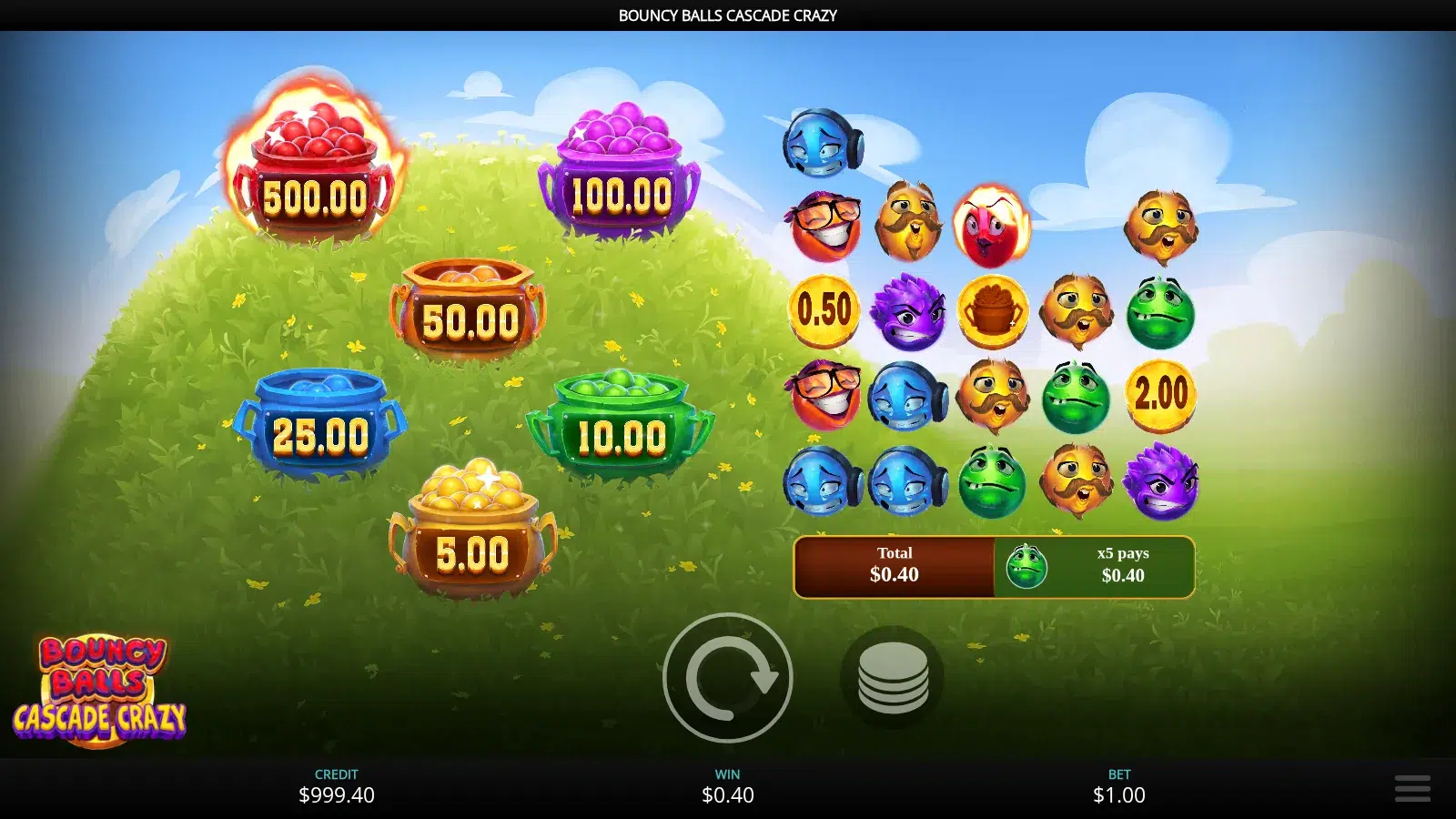
Six cartoon balls with faces bounce around a 5×5 grid, and six pots are on the hill beside them, one in each ball colour. Those pots contain the full feature set of the Bouncy Balls Cascade Crazy demo, since there is no bonus round here. No wild, no scatter, no free games, and nothing of the 25 fixed lines, tripled feature wins, or retrigger caps that run Eyecon’s older classics. The pay sheet does carry a red tier worth 5,000x the total bet, which looks like a maximum and isn’t one. That’s what a single cluster of 17 red balls pays, on a grid that keeps dropping new symbols in after it lands.
Every cluster win sets off a cascade, so the winners vanish, the survivors drop, fresh balls fall in, and the grid is read again until nothing links. Coins carrying values land among the balls, and a winning coin cluster pays the total of the values showing on it. A coin can also carry a pot image, which turns that win into a pot prize drawn at random. The Random Pot Win stands apart from all of it, because after any coloured win there’s a chance the pot in the matching colour is awarded too, so a five-ball yellow link worth 0.2x can finish the spin with the yellow pot’s 5x attached.
A cluster needs five or more of the same ball linked adjacently, up and down or side to side. Diagonal neighbours only join in when a matching ball connects them horizontally or vertically, so a cluster grows as a branching shape rather than a block. With 25 positions available, the upper tiers occupy much of the grid. Only the highest win stands on each cluster, and the grid totals every separate cluster before the cascade clears them.
Coins land with values on their face, running from 0.5x to 2x, and five or more linked coins count as a cluster on their own. The prize is the sum of what those coins show rather than a tier from the pay sheet, so a coin cluster can out-pay a colour cluster of the same size. A coin showing a pot instead of a number turns the win into one of the six pot prizes, chosen at random.
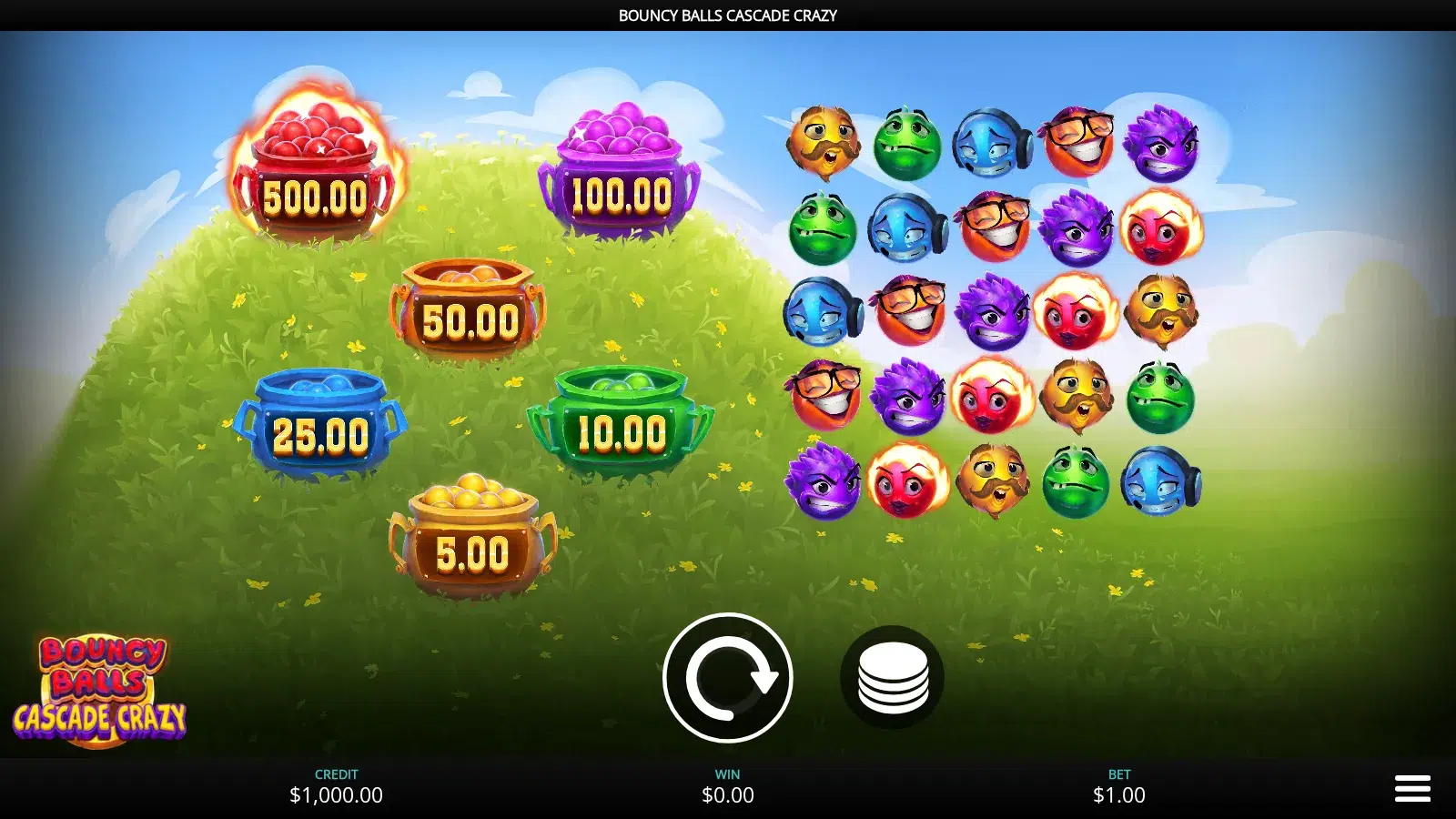
The six pots run 5x, 10x, 25x, 50x, 100x, and 500x, climbing yellow through to red, and the red one burns on its hill while the rest are still. The colour that paid decides which prize is in play. A yellow cluster can only pull the 5x pot down; a red one is reaching for 500x. No trigger, no counter, no pick screen, and nothing on the grid says it’s coming. Eyecon has been owned by Playtech since 2017, and the studio’s demo range now stretches from hand-drawn toy boxes to this.
Five matching balls have to touch before anything pays, up and down or across, and a diagonal only counts once a matching ball connects it back to the group. Each cluster is settled in turn, with its own win shown in the TOTAL panel as it goes, and only the highest win stands on any one cluster. Wins from different clusters are added, then the cascade clears the winners and drops replacements in. That loop repeats until a drop arrives with nothing linked, at which point a spin actually finishes.
Eyecon’s older Bouncy Balls, Bouncy Balls 2, and Bouncy Bingo Balls are line and bingo-style games with none of this falling-grid format, so the 2025 cascade slot carries the family name forward rather than its maths. Anyone arriving from the earlier three is starting from scratch, since none of them asks you to read the grid as a shape.
The demo returns 95.146%, the exact figure for the build Eyecon serves, and Eyecon’s own rating for the game is medium, which is where this review lands it too. Medium is a fair read of a table that pays something for five of anything and wants two-thirds of the grid before the numbers turn serious. The largest number on the pay sheet is the red ball’s 5,000x, and that belongs to a single cluster of 17 or more, not to the spin, because separate clusters add, and each can cascade into another.
The six colours are not six versions of one ladder. Yellow starts at 0.2x for a cluster of five and tops out at 50x; green starts at 0.4x and reaches 100x, and it gets there at 16 balls, whereas every other colour waits for 17. Blue’s five-cluster pays 0.6x against a 500x top, orange runs 1x to 1,000x, purple 2x to 2,000x, and the red flaming ball opens at 5x and finishes at 5,000x. The spread widens as the colour gets rarer, so red is worth 25 times yellow at five symbols and 100 times yellow at the top of the sheet.
Coin clusters sidestep the table completely, paying whatever the coins on them add up to, so these rows only describe half of what a spin can do.
| Symbol | 5 | 6 | 7 | 8 | 9 | 10 |
|---|---|---|---|---|---|---|
| Red (flaming) | 5x | 10x | 20x | 40x | 80x | 125x |
| Purple (spiky) | 2x | 5x | 10x | 15x | 25x | 50x |
| Orange (glasses) | 1x | 2x | 5x | 10x | 15x | 25x |
| Blue (headphones) | 0.6x | 1x | 2x | 3x | 5x | 10x |
| Green | 0.4x | 0.6x | 0.8x | 1x | 1.5x | 2x |
| Yellow (moustache) | 0.2x | 0.4x | 0.6x | 0.8x | 1x | 1.5x |
| Symbol | 11 | 12 | 13 | 14 | 15 | 16 | 17+ |
|---|---|---|---|---|---|---|---|
| Red (flaming) | 150x | 200x | 250x | 500x | 1,000x | 2,000x | 5,000x |
| Purple (spiky) | 100x | 150x | 200x | 250x | 500x | 1,000x | 2,000x |
| Orange (glasses) | 50x | 75x | 100x | 150x | 200x | 500x | 1,000x |
| Blue (headphones) | 15x | 20x | 50x | 100x | 150x | 200x | 500x |
| Green | 4x | 10x | 15x | 25x | 50x | 100x | 100x |
| Yellow (moustache) | 2x | 2.5x | 5x | 7.5x | 12.5x | 25x | 50x |
A cluster slot with no bonus round shouldn't work this well, and the Random Pot Win is why this one does. Cascades handle the small wins, the pots handle the rare ones, and the 5,000x red tier is a paytable row rather than a promise. Simple, fair, and short on anything to chase.
The Random Pot Win decides what this game is. There’s no trigger to hunt for and no counter filling up towards it. A coloured cluster pays, and the pot in that colour may simply arrive behind it, anywhere from 5x on yellow to 500x on red. That’s the entire bonus structure, folded into a coin flip that happens after the win rather than before.
The design leaves the rest of the slot to the grid, and the art is happy to carry it. Six faces, a green hill, a blue sky, and pots parked in the frame for the whole spin as a reminder of what’s available. The balls read clearly at cluster size, which matters on a 5×5 board where wins are shapes rather than rows.
The numbers behind the colour are ordinary and honest. A 95.146% return is mid-table for a 2025 cluster release, medium volatility is the right label, and the 5,000x red tier is a lottery ticket on a board of 25 positions rather than a target. Cluster games that build a multiplier as they cascade, Cosmic Clusters among them, have far more to escalate than this does. What this has instead is a feature that can fire on any win, including a small one.
In free play, the cascades do most of the talking and the pots do the rest, and none of it is hard to follow. Whether that’s enough depends on what you want from a cluster game, because the version with no bonus round is also the version that never makes you wait for one.