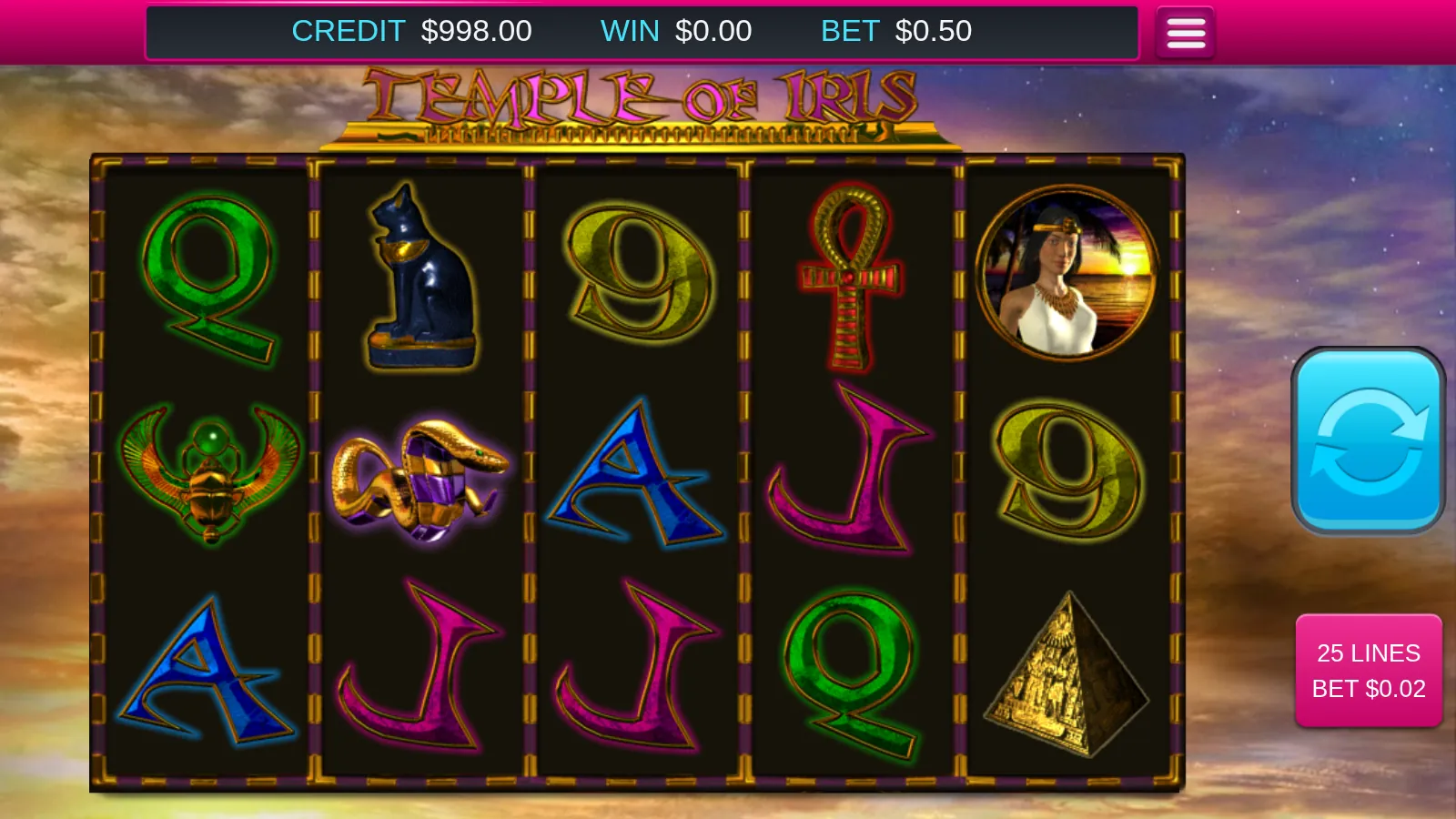
Eyecon’s own company timeline places Temple of Iris in 2003, three years before Fluffy Favourites, making it the oldest slot still running in the studio’s live catalogue.
The numbers have not moved since: twenty-five line diagrams, a Priestess who returns 380x with five on a line and doubles any line she joins, a Pyramid worth 450x with five on a line, and 15 free games with every prize tripled. That set reappears to the decimal in Shaman’s Dream, Secret Garden, and Happy Birthday, all later skins of this build. What the demo shows is the first place those figures were used, on a shell that still returns 95.436%.
The Priestess is the top payer and the substitute at once, and that single decision shapes everything below her. Five of her on a selected line return 380x, four return 80x, three return 8x, and two return 0.4x. She replaces every symbol on the reels apart from the Pyramid, and any line win she completes is doubled under the game’s substitute rule. So, the largest figure on the line grid has two routes to it, and one of them depends on the most expensive icon already being there.
Three or more scattered Pyramids anywhere on the board award 15 free games, a fixed count rather than a ladder that grows with the number of scatters. Every prize is tripled while the round runs, including scatter wins, and the feature keeps the line count and stake that triggered it. Retriggers are capped at 15, so the round can run long without running open-ended. Nothing else shifts once the feature starts: no extra wilds, no multiplier meter, no second screen, leaving the tripling to do all the work.
The Pyramid pays from two symbols anywhere on the reels at 2x, then 5x for three, 20x for four, and 450x with five on a line. That 450x is the highest multiplier on the sheet, ahead of the Priestess at 380x, which is unusual for a 25-line classic, where the premium symbol normally has the highest multiplier. For each scatter, the game adds the highest scatter win only to the line wins.
The furniture around it is standard for Egyptian slots, with a scarab, an Eye of Horus, a cobra, a cat, and an ankh above the card royals. Temple of Iris 2 and a Jackpot edition carry the name forward.
Temple of Iris is one of the Eyecon classics that still lets you play fewer than its 25 lines, and the info screen draws each one as a numbered diagram. All line wins pay from the leftmost reel rightwards; only the highest win on each selected line counts, and the game totals every winning line before the figure appears. The Pyramid ignores that structure completely, since scattered wins pay from any position on the board rather than along a line.
The shell is as plain as the artwork. A single blue spin button is fixed to the right of the reels, with a panel below it reading the live line count and the bet on each line. Tap that panel, and the bet screen opens, carrying two vertical sliders, one for lines and one for the per-line bet; drag either, and the total on the top bar updates with it. The hamburger button at the top right opens the options list, where the info screen and sound control are. There is no autoplay, no turbo, and no quick spin, and neither slider labels an end value, so that panel is the only running readout of how the game is set.
The slot rules show a return of 95.436%, and that is the build the demo runs on. Eyecon licenses the title in two published versions, 93% and 95%, a spread of two points from bottom to top, which is standard across the Eyecon range and puts the demo on the upper one. The studio rates the game medium for volatility, and this review keeps it there. The largest value on the sheet is the 450x Pyramid, and the game is plain about how that one is counted, since “scatter wins are multiplied by the total wager”.
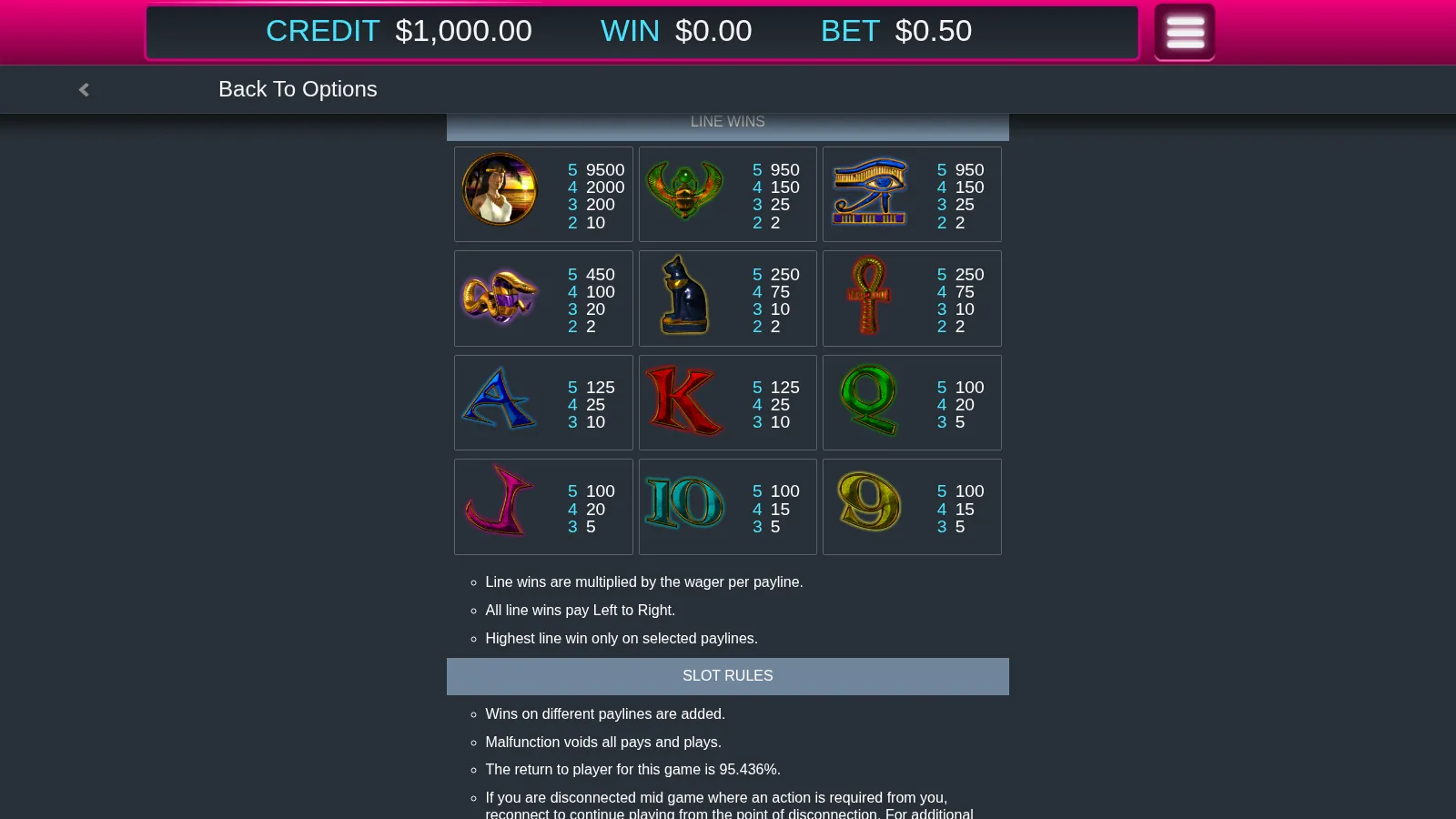
The sheet runs down from the Priestess at 380x to four royals that all stop at 4x, and the drop between the two ends is steep. Six picture symbols pay from two; the card ranks need three, and the Pyramid is listed on its own because its five-symbol figure beats everything on the line grid.
| Symbol | 2 | 3 | 4 | 5 |
|---|---|---|---|---|
| Priestess (wild) | 0.4x | 8x | 80x | 380x |
| Scarab | 0.08x | 1x | 6x | 38x |
| Eye of Horus | 0.08x | 1x | 6x | 38x |
| Cobra | 0.08x | 0.8x | 4x | 18x |
| Cat | 0.08x | 0.4x | 3x | 10x |
| Ankh | 0.08x | 0.4x | 3x | 10x |
| A | – | 0.4x | 1x | 5x |
| K | – | 0.4x | 1x | 5x |
| Q | – | 0.2x | 0.8x | 4x |
| J | – | 0.2x | 0.8x | 4x |
| 10 | – | 0.2x | 0.6x | 4x |
| 9 | – | 0.2x | 0.6x | 4x |
| Pyramid (scatter) | 2x | 5x | 20x | 450x |
Players who want to see where Eyecon's classic range began will get that from Temple of Iris and not much else. The free games are clean, with 15 of them and every prize tripled, the 450x Pyramid gives the sheet a real top value, and 95.436% is a fair return for the type. Against it, the board carries one feature, the art is two decades old, and long stretches between triggers are the medium rating showing its working. It is studio history that still plays cleanly, rather than a 2026 pick on merit.
Fifteen free games, with every prize tripled, is the entire feature list, and everything else in the game exists to get there. A tripled Priestess line is the largest thing the demo can put on screen; a tripled Pyramid is close behind, and both arrive from the same trigger. Away from that round, there is a flat 25-line board with no meter, no pick screen, and no second scatter to break the rhythm.
The art is a 2003 work ported to a modern client rather than redrawn, and it looks it. Symbols are lit with a hard glow against black reels, the royals are coloured letters, and the Priestess portrait has the soft focus of a game built for dial-up. Set beside a current Egyptian release such as Eye of Horus Rise of Egypt, the reels are quiet, and the sound does little between spins. The one detail that has aged well is the Priestess frame itself, a sunset portrait that marks her out from the flat icons around her before you know what she pays.
Age on its own earns nothing, and the honest case against this page is that a 95.436% return, one feature, and a medium rating describe a game several newer titles match with better art. That case holds. What survives it is the shape of the sheet, where a 450x scatter outranks a 380x premium, and six symbols pay from two, keeping small returns arriving often enough to hold a session together. Eyecon has spent twenty years putting fresh art on shells of this weight, and most of the studio’s catalogue still uses 25 lines and one round of free games.
What free play here gets you is the original of a build the studio has never had cause to replace, and at the return it still gives for it.