Big Bass Bonanza Megaways

Big Bass Bonanza Megaways Stats
Free Spins & Bonus
- Free Spins
- “Hit 3 or more Scatter symbols to trigger the Free Spins feature.” 3x scatter = 10 free spins; 4x = 15 free spins; 5x = 20 free spins; 6x = 25 free spins. Scatter appears on all reels.
Symbols & Pays
- Wild
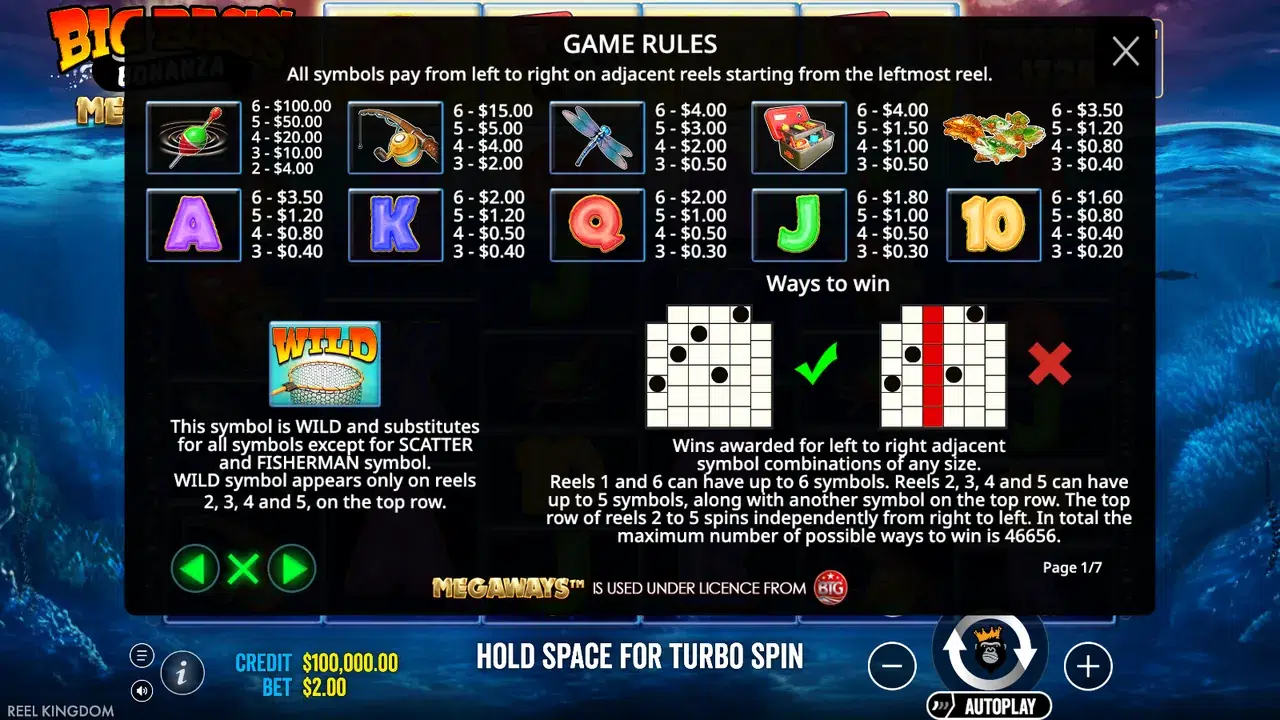
- “This symbol is Wild and substitutes for all symbols except for Scatter and Fisherman symbol. Wild symbol appears only on reels 2, 3, 4 and 5, on the top row.”
46,656 Megaways to Win
Big Bass Bonanza Megaways prints its own limit on the rules page. Forty-six thousand, six hundred and fifty-six ways is the maximum this board will ever show, and the reason sits in the reel heights, where four of the six columns stop at five symbols with one extra passenger riding a top row of their own. Two large slot databases still publish 117,649 for it. The game demo info panel disagrees.
Reel Kingdom built this fishing slot as the third entry in the Big Bass series, arriving in November 2021 about eleven months after the original Big Bass Bonanza and two months after its first sequel. Pragmatic Play publishes it; the Reel Kingdom credit sits in the corner of the load screen, and the Megaways name is used here under licence from Big Time Gaming, a notice printed on the opening rules page rather than tucked into a footer.
How the Demo Works
Tumbling reels and a collect feature shouldn’t get along. One clears winning symbols off the screen; the other needs cash values to stay put long enough for somebody to come and gather them. The answer here is a rule that applies only inside the bonus, and it’s the most consequential line in the whole rules panel.
The Fish That Refuse to Tumble
In standard play, a fish carrying a cash value behaves like everything else. Win with it, and it bursts, the column drops, fresh symbols fall in from above. Free spins flip that behaviour. The fish stop exploding altogether. They slide to the bottom of the screen while the symbols around them keep tumbling, so a value you spotted on spin one can still be sitting there when a fisherman finally lands. The possible values run 2x, 5x, 10x, 15x, 20x, 25x, 50x and, at the very top of the range, 4,000x the total bet. At the $2.00 stake the capture ran on, the smaller ones showed as $4.00, $10.00, $20.00 and $30.00.
Scatters, Spins and the Fisherman Ladder
Three scatters open the round at ten free spins, four give fifteen, five give twenty, and six give twenty-five. The fisherman then appears on every reel, sweeping up every cash value on screen before being collected himself. Gather four of them and the round restarts with ten more spins and a multiplier bolted onto collections and wins alike, rising 2x, then 3x, then 10x across the first, second and third restarts. After the third, no more restarts are possible.
Dynamite, Bazooka and the Dead Spin Problem
A collect feature has an obvious failure state: a fisherman standing on a board with nothing to collect. Two answers were written into the free spins for exactly that case. When only one or two fishermen are on screen with no fish anywhere, a dynamite blast can scatter fresh money symbols into random positions at the end of the spin. A bazooka can fire instead, clearing every symbol except the fishermen and letting the reels refill around them. Both are random, both are new to this board, and special reels run throughout the feature.
The Wild’s One Address
The wild has a single address. It shows only on the top row of reels 2, 3, 4 and 5, substituting for everything except the scatter and the fisherman, which keeps it out of the two tall outside columns where a substitution would cover the most ground.
How to Play
Six columns, and only two of them are free to grow. Reels 1 and 6 can each stack up to six symbols, while reels 2 through 5 hold five apiece and take a sixth from a top row that spins independently, right to left, above them. Six heights multiplied together give 46,656, and the rules panel states it flatly. “In total the maximum number of possible ways to win is 46656.” That’s why the counter above the reels reads what it reads instead of the 117,649 a seven-row Megaways board produces.
Stakes, Balance and the 96.72% Return
Stakes start at $0.20 and reach $240.00, and the route into free spins is the same at every level, which is three scatters or better. The free play build starts at $100,000. The RTP reads 96.72%.
What the Symbols Pay at a $2.00 Bet
The figures below are based on the $2.00 stake the demo ran on. Six of a kind is the most any column count allows here, and the bobber float is the only symbol that pays from two, adding 2x for the pair.
| Symbol | 6 | 5 | 4 | 3 |
|---|---|---|---|---|
| Bobber Float | 50x | 25x | 10x | 5x |
| Fishing Rod | 7.5x | 2.5x | 2x | 1x |
| Dragonfly | 2x | 1.5x | 1x | 0.25x |
| Tackle Box | 2x | 0.75x | 0.5x | 0.25x |
| Small Fish / A | 1.75x | 0.6x | 0.4x | 0.2x |
| K | 1x | 0.6x | 0.25x | 0.2x |
| Q | 1x | 0.5x | 0.25x | 0.15x |
| J | 0.9x | 0.5x | 0.25x | 0.15x |
| 10 | 0.8x | 0.4x | 0.2x | 0.1x |
Ultimate Slots Verdict
Anyone arriving at Big Bass Bonanza Megaways for the format's biggest ways count will find a third of it, while anyone arriving for the fisherman collect gets the one rule change that lets it survive tumbling reels at all. The badge oversells the board; the free spins design earns most of it back.
Detailed Review
Where the Fenced Board Pays Off
The tumble-persistence rule is the game’s best design feature. It turns a free spin into an accumulation rather than a reset, so a 50x fish that lands early is still worth something eight spins later. Put that alongside a fisherman ladder climbing to a 10x multiplier on collections and wins, and the round builds pressure the way the franchise’s fixed-line versions never quite manage.
The 96.72% return is generous for the series, and the tumbles give standard play more to do than twelve fixed lines ever did.
Where the Badge Outruns the Board
Forty-six thousand ways is a lot in absolute terms and modest for the format, and the counter spends most of its life far below even that. The 4,000x cap matches the sequel that arrived two months earlier on a smaller, cheaper-looking grid, so the licence buys visual scale and win frequency without moving the top end. Free spins carry the whole game, too. Miss the scatters and the cash values on screen are decoration, because nothing outside the bonus collects them.
What the Shorter Board Changes
The number that matters is the one the rules page prints without apology, and published reviews still carry 117,649 for this game. That figure belongs to a board with seven rows. This one doesn’t have seven rows anywhere.
17,280, then 1,600, then 1,080, then 648.
Those are four consecutive readings from the live counter during capture, and they’re the honest picture of what the board hands you spin to spin. A Megaways ways count is a lottery of reel heights, and these heights are pinned back on four columns out of six. The practical effect is fewer huge-coverage spins and a steadier drip of small ones, which suits a game whose payoff sits in accumulated fish rather than one monstrous line.
Free spins are where the real work went in. Dynamite and Bazooka fire only when one or two fishermen are stranded with nothing to collect, which is a design team looking straight at the round’s dead spot and patching it, and a tell about how that spot feels without them. Watching a 50x value sit at the bottom of the screen through four tumbles while the collect symbol refuses to show is precisely the anticipation the feature is meant to manufacture, and the patches arrive often enough to keep it pointed forward rather than letting it curdle.
Against Big Time Gaming’s own Bonanza Megaways, this is the tamer and more structured use of the format, trading wildly swinging reel heights for a collect round that always knows what it wants. Put it beside the Megaways version of Fishin’ Frenzy, and it’s the busier lake, and the more generous one.
Neither comparison rests on the ways count, which is the claim the badge keeps making and the game keeps quietly declining.
Big Bass Series at a Glance
All Big Bass Series ›| Game | RTP | Max win | Volatility |
|---|---|---|---|
| Big Bass Bonanza Megaways | 96.72% | 4,000x | High |
| Big Bass Splash | 96.71% | 5,000x | Very High |
| Big Bass Bonanza | 96.71% | 2,100x | High |
| Big Bass Bonanza 1000 | 96.51% | 20,000x | High |
| Big Bass Splash 1000 | 96.52% | 25,000x | High |
| Big Bass Amazon Xtreme | 96.07% | 10,000x | High |