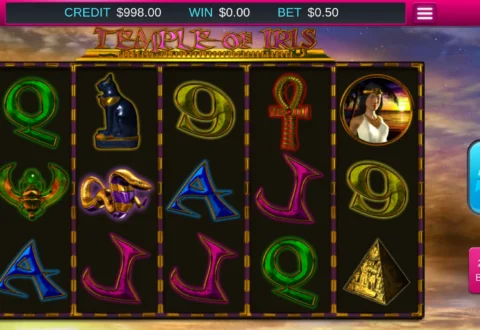
Luxor of Cleopatra

Luxor of Cleopatra Stats
RTP & Maths
- RTP by Mode
- Buy Free Spins 96.56%
Free Spins & Bonus
- Free Spins
- 3/4/5 scatters = 10 spins
- Bonus Buy
- Free Spins 30x
Cleopatra’s Vault and the Twenty-Key Problem
Luxor of Cleopatra pays out exactly ten free spins whether three, four or five scatters trigger them, and that flat award tells you where Pragmatic Play has hidden this slot’s real game. Spare lotus flowers convert to cash instead of extra spins. The round itself belongs to the Vault, a meter that opens at 20x beside the reels and swells every time a Wild Multiplier lands, with a top value of 12,500x. Marking all 20 screen positions with keys before the spins run out is the only way to collect it.
Demo Play Features
Ten Spins, No Matter the Trigger
Three, four or five lotus scatters open the round, and every count awards the same ten spins. The spares still pay. Scatters carry cash of 1x your total bet for three, 5x for four and 25x for five, and once the round is running, any three or more that land push 10x, 50x or 250x straight into the Vault rather than adding spins. There’s no conventional retrigger at all. The feature also switches to its own special reel strips, and if a round’s total reaches the 12,500x cap it ends immediately, paying the capped amount and forfeiting whatever spins remain.
How the Vault Fills
The Vault opens at 20x your total bet and sits beside the grid for the whole feature. Any spin where Wild Multipliers hit adds a random amount, and the possible sums scale steeply with how many are involved.
A single coin adds between 1x and 50x, two stretch to 2,500x, and from three upwards the full 12,500x enters the draw. Winning the total is a separate job. After the first spin, eight random positions on the middle three reels light up with keys, and every Cleopatra portrait that lands on an unlit position marks it.
All 20 positions on the 5×4 screen need keys by the round’s end for the Vault to pay, and since the head start never touches reels 1 and 5, those eight outer positions must all be earned by Cleopatra landing on them directly.
Two Wilds, Two Jobs
In regular play, a pyramid wild appears on reels 2, 3 and 4, substituting for everything except the scatter and paying nothing on its own. Free spins replace it with the coin-styled Wild Multiplier, which lands on all five reels, pays as a symbol in its own right, and stamps a x2 on every win it joins. Coins in the same way compound, so three of them turn a modest ways hit into an x8 one.
Multiplying wilds are familiar Pragmatic territory, 5 Lions Megaways among the better-known examples, but here each coin does double duty, boosting the win in front of you while feeding the Vault at the same time.
The 30x Buy
Paying 30x your total bet triggers the round instantly, and the bought spin always arrives with exactly three scatters, so a purchase never banks the 5x or 25x cash a natural four- or five-scatter trigger would. For a feature with this much range, 30x sits at the cheap end of the market.
The published return also lands a shade above the standard rate, 96.56% against 96.51%, which flips the usual relationship between buying and spinning for it.
How to Play
The Cleopatra Portrait, Scarab and Ankh Ring
Four of Luxor of Cleopatra’s symbols pay for just two of a kind, and it’s an odd quartet. The Cleopatra portrait, the scarab and the ankh ring earn the privilege as premiums, then the humble 9 joins them while the 10 directly above it needs three. Beyond that quirk the format is orthodox, 1,024 ways on a 5×4 grid, with pays forming when matching symbols hit adjacent reels from the far left and each way settling only its best combination.
Stakes run from $0.20 to $240, built in a menu that multiplies a coin value against a bet level. A spin-speed button cycles through quick and turbo, holding the spacebar does the same job, and the demo hands you $100,000 in play money, so the balance will outlast your curiosity.
Pragmatic rates this one medium volatility, though its own screens disagree. The loading badge lights all five bolts while the rules pages show three of five, and the rules have it right, at least for regular play. The default return is 96.51%, with 95.51% and 94.56% builds also in circulation, so the info pages where you play will show which version is running.
Paytable
Every figure below is a per-way award measured against your full stake, and the top of the table is strikingly flat, with five Cleopatras returning just 5x per way. Volume is the point instead, since 1,024 ways can settle many small awards on a single spin.
| Symbol | 2 of a kind | 3 of a kind | 4 of a kind | 5 of a kind |
|---|---|---|---|---|
| Wild Multiplier (free spins only) | 0.5x | 5x | 12.5x | 25x |
| Cleopatra | 0.25x | 2.5x | 3.75x | 5x |
| Scarab | 0.1x | 2x | 3x | 4x |
| Ankh ring | 0.1x | 2x | 3x | 4x |
| Gold coin | – | 1x | 2.5x | 3.5x |
| Eye of Horus | – | 1x | 2.5x | 3.5x |
| A, K | – | 0.25x | 1.5x | 3x |
| Q, J | – | 0.15x | 1x | 2.5x |
| 10 | – | 0.15x | 0.5x | 2x |
| 9 | 0.1x | 0.15x | 0.5x | 2x |
| Scatter (any positions) | – | 1x | 5x | 25x |
Scatter amounts are totals rather than per-way pays. The pyramid wild has no row because it never pays directly, and the Wild Multiplier appears during free spins only.
Screenshots

The splash screen showcases the glistening gold graphics and the luscious Cleopatra standing next to the reels.

Graphical image of the above payout table.

This page on the info screen explains how the free spins, scatters, and wilds work.
Ultimate Slots Verdict
Players who enjoy watching a collect meter build will get far more from Luxor of Cleopatra than anyone who wants action between bonuses, because the Vault carries this game on its own. It's a clever second prize with real tension in it; everything around it is competent, familiar Egyptian ways furniture.
✓ What We Like
- The Vault runs as a second prize alongside normal free spins wins, with single additions reaching 12,500x
- Extra trigger scatters pay instant cash, 5x for four and 25x for five, instead of vanishing into the flat award
- Wild Multiplier coins pay up to 25x per way and compound with each other inside the same win
- Buying at 30x is cheap for the sector, with a published 96.56% rate that actually tops regular play
- A 12,500x cap on a medium volatility rating is a rare pairing at this scale
- Lavish chamber presentation, with a sunset scene change when the bonus begins
✗ What Could Be Better
- Nothing happens between features beyond a payless pyramid wild on the middle reels
- The Vault pays on all 20 keys or not at all, and nineteen is a brutal way for a big total to die
- No retrigger means the round never stretches past ten spins
- Line pays are shallow throughout, topping out at 5x per way for five Cleopatras
Detailed Review
Under the Gold Leaf
Take the Vault out of Luxor of Cleopatra and count what’s left. A 5×4 grid, 1,024 ways, a pyramid wild on the middle reels, a scatter round with multiplying x2 wilds. Every major studio ships that exact game in Egyptian dress, and a review of it would run three paragraphs. The Vault is the argument for this page.
Calling the rest stock does undersell how well it’s finished. The chamber setting drips with gold leaf and lotus water, free spins move the scene to a sunset terrace, and a ways engine whose wilds pay, double and compound is a sturdy frame before the collect layer even switches on. Egyptian slots have never sold on novelty anyway; the theme endures precisely because players know what they’re getting. On those terms this July 2026 release holds up fine, and a 12,500x cap hanging on that frame is reason enough for a look before the Vault enters the conversation.
Watch one full cycle and the design logic shows itself. The round opens, the Vault reads 20x, and after the first spin eight of the twenty positions light up with keys before you’ve done anything, a head start that makes the target feel closer than it is. A coin lands on reel five and the total ticks up by some random amount, perhaps 2.5x, perhaps 50x, then a beat later three lotus flowers drop in and shove another 10x on top. Cleopatra portraits arrive one at a time, each marking whichever unlit position it happens to cover, and by the seventh spin you can be staring at eighteen keys, a figure worth a few hundred times your stake, and three spins left needing two exact positions filled on a twenty-position screen. Portraits land where keys already sit more often than feels fair. When the last spin resolves on nineteen, the number simply goes dark, the round pays its ordinary wins, and the deflation is as carefully designed as the anticipation that preceded it.
On volatility, the game argues with itself. The splash screen lights every bolt on its badge, the rules pages light three and call it medium, and both are defensible depending on which half you’re describing. Regular play drips small ways wins steadily enough to justify the label. The Vault does not, and since the bonus lands roughly once every 84 spins on average, a session’s fortunes swing closer to the Zeus vs Hades demo than a medium badge usually allows.
Collecting is a Pragmatic habit by now. The money fish of Big Bass Bonanza and the Vault here are cousins, but this one arrives with a condition none of its relatives carry, an all-or-nothing key hunt that can erase the whole pot on the final spin. That single condition is where Luxor of Cleopatra finds an identity, for better and worse, and it’s the honest reason the game exists at all.
Whether it’s enough depends on what you spin for. As a piece of engineering the Vault earns its keep, layering growth, cash injections and a completion puzzle into ten spins without muddling any of them. As a whole slot, the maths around it stays ordinary, the pays per way are shallow, and between features there’s nothing to do but wait. Average bones, one excellent idea.
Put it to the test in free play. Run a stretch of bonus rounds on the demo balance, count how often the twentieth key actually arrives, and note what the Vault was showing each time it didn’t. Your answer to that experiment settles whether this is your kind of slot far quicker than any score out of five will.